Key physico-chemical properties
Which properties make nanobubbles behave differently from ordinary bubbles?
On this page
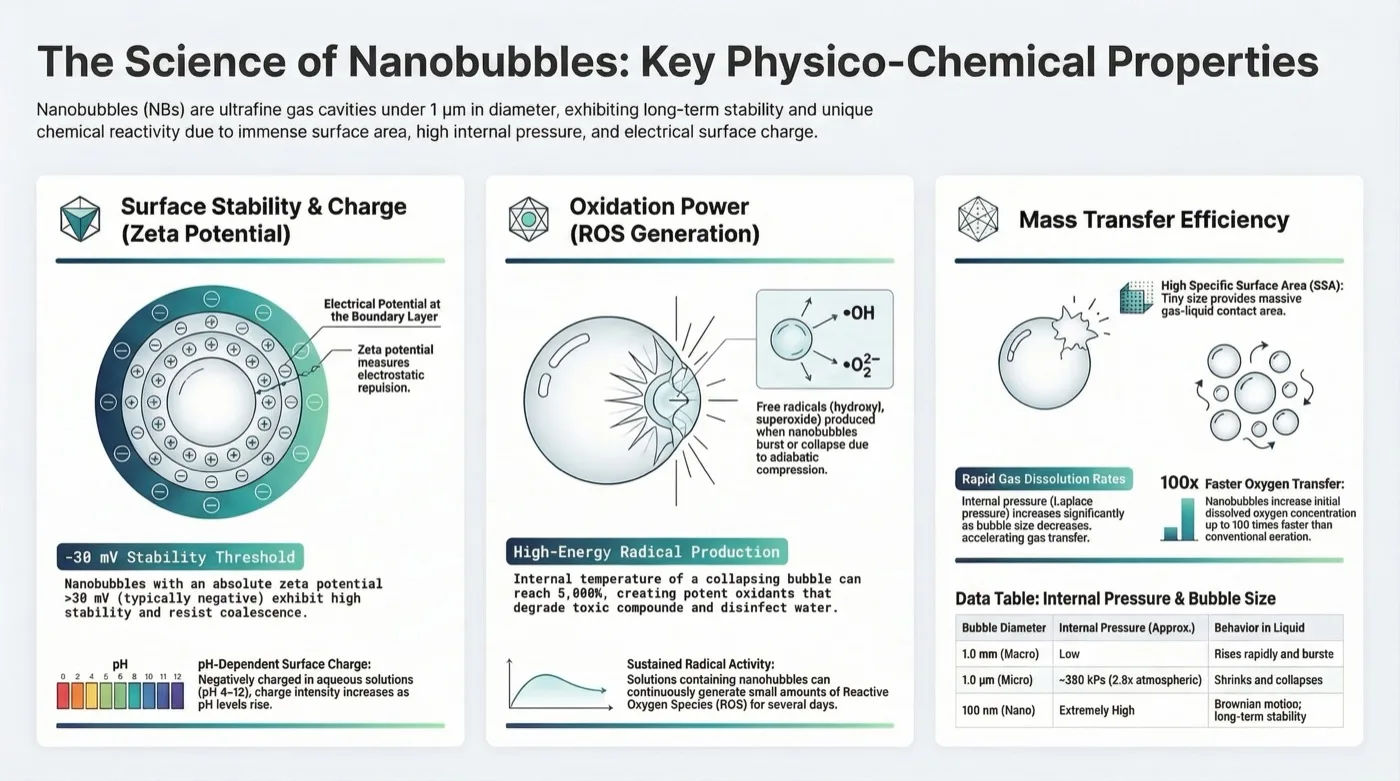
Surface charge and zeta potential
Nanobubbles in water carry a negative surface charge. , the electric potential at the slipping plane around the bubble, typically measured −20 mV to −50 mV at neutral pH. The charge arises largely from the preferential adsorption of hydroxide ions (OH⁻) at the gas–liquid interface Hewage et al., 2021; Ushikubo et al., 2010.
The magnitude of that potential is used as an indicator of stability. High absolute values, above 30 mV, generate electrostatic repulsion strong enough to keep bubbles from coalescing and aggregating, so they can stay dispersed for long periods Akshit et al., 2024. This is the same charge that the surface-charge model of stability relies on, described in Generation mechanisms and stability.
The potential is not fixed; it changes with the water. It becomes less negative, or turns positive, in acidic conditions; it varies with the gas inside the bubble; and it depends on ionic strength Ahmed et al., 2018; Takahashi et al., 2021.
Reactive oxygen species
Collapsing bubbles have been reported to generate (ROS). The main radical reported is the hydroxyl radical (·OH), although superoxide anions (O₂•⁻) and singlet oxygen (¹O₂) have also been identified Liu et al., 2016; Takahashi et al., 2007.
The radicals form during collapse, when a bubble shrinks and disappears. Two mechanisms have been proposed for how that happens.
Adiabatic compression
Rapid shrinking compresses the gas inside the bubble and heats it. Review articles cite local temperatures of up to 5,000 K, together with high pressure, which thermally decompose water vapor into radicals Agarwal et al., 2011; Akshit et al., 2024.
Ionic accumulation
As a bubble shrinks, the density of ions at its interface, specifically H⁺ and OH⁻, increases sharply. When the bubble collapses, the electrical energy stored in that accumulated charge is released and triggers radical formation. This route was studied by spin-trap electron spin resonance (ESR) in bulk nanobubbles in electrolyte solutions Takahashi et al., 2021.
Mass transfer
Nanobubbles transfer gas into water faster than larger bubbles. Studies and reviews reported significantly higher rates for nanobubbles than for macrobubbles, driven by their very large specific surface area (SSA) relative to their volume Fan et al., 2010; Akshit et al., 2024.
Internal pressure adds to the effect. The high internal (Laplace) pressure of a nanobubble increases the solubility of its gas in the surrounding liquid, following Henry's law, which allows supersaturated solutions to form without rapid off-gassing Ebina et al., 2013.
What this means in practice
In practice, each property points to a measurement rather than an assumption. Zeta potential changes with pH, ionic strength and gas, so a value measured in pure water in a laboratory says little about a site's water: measure it in the water that will actually be treated, with pH and conductivity recorded alongside.
Radical formation is inferred from specialized methods such as the spin-trap ESR named above, not from routine water tests. A site that cares about oxidation should look for measured changes in the target compound, with an untreated control, rather than assume radicals are present.
For gas transfer, log (dissolved oxygen) in mg/L over time against a conventionally aerated or untreated control, and record water temperature, since gas solubility depends on it. A DO probe measures dissolved gas, not bubbles, so pair it with bubble characterization, as described in Characterization and measurement.
Limits and open questions
The zeta potential range and the 30 mV threshold come from laboratory samples and a review; the threshold indicates, rather than proves, stability, and values in water with high ionic strength or organic matter may differ.
The 5,000 K figure is cited from review articles, not from a direct measurement in a bulk nanobubble suspension. Part of the radical evidence comes from collapsing microbubbles, and the lesson gives no radical concentrations, so it cannot say how much ROS forms in treated water. One study points the other way: standing oxygen nanobubbles at room conditions did not degrade benzoic acid, a hydroxyl radical scavenger, over 24 hours, and no hydroxyl radical signal was detected by electron paramagnetic resonance; the authors also found that a fluorescent probe gave a false positive Chae et al., 2023.
The mass transfer comparison is qualitative: the lesson reports no transfer coefficient or oxygen transfer efficiency for any device.
Questions
What is zeta potential, and why does it matter for nanobubbles?
Zeta potential is the electric potential at the slipping plane around a bubble. For nanobubbles it typically measured −20 mV to −50 mV at neutral pH. A magnitude above 30 mV is cited as enough repulsion to keep bubbles from merging, which helps explain why they stay dispersed.
Do nanobubbles produce free radicals?
Studies reported radicals, mainly the hydroxyl radical, when bubbles collapse, with superoxide and singlet oxygen also identified. Two mechanisms are proposed: heating from rapid compression and the release of charge concentrated at a shrinking interface. The lesson does not give radical concentrations, so the amount in treated water is not established.
Why do nanobubbles transfer gas into water efficiently?
Their surface area is very large relative to their volume, and their high internal pressure raises the solubility of the gas around them. Studies reported higher mass transfer rates than for macrobubbles. The comparison is qualitative, so a site should log dissolved oxygen against a control.
References
- Hewage, S. A., Kewalramani, J., Meegoda, J. N. (2021). Stability of nanobubbles in different salts solutions. Colloids and Surfaces A: Physicochemical and Engineering Aspects, 609, 125669. https://doi.org/10.1016/j.colsurfa.2020.125669 ↩
- Ushikubo, F. Y., Furukawa, T., Nakagawa, R., et al. (2010). Evidence of the existence and the stability of nano-bubbles in water. Colloids and Surfaces A: Physicochemical and Engineering Aspects, 361, 31-37. https://doi.org/10.1016/j.colsurfa.2010.03.005 ↩
- Akshit, F., Mao, T., Mohan, M. S. (2024). Future perspective of nanobubble technology in dairy processing applications. Trends in Food Science & Technology, 147, 104420. https://doi.org/10.1016/j.tifs.2024.104420 ↩
- Liu, S., Oshita, S., Kawabata, S., et al. (2016). Identification of ROS Produced by Nanobubbles and Their Positive and Negative Effects on Vegetable Seed Germination. Langmuir, 32, 11295-11302. https://doi.org/10.1021/acs.langmuir.6b01621 ↩
- Takahashi, M., Chiba, K., Li, P. (2007). Free-Radical Generation from Collapsing Microbubbles in the Absence of a Dynamic Stimulus. The Journal of Physical Chemistry B, 111, 1343-1347. https://doi.org/10.1021/jp0669254 ↩
- Agarwal, A., Ng, W. J., Liu, Y. (2011). Principle and applications of microbubble and nanobubble technology for water treatment. Chemosphere, 84, 1175-1180. https://doi.org/10.1016/j.chemosphere.2011.05.054 ↩
- FAN, M., TAO, D., HONAKER, R., et al. (2010). Nanobubble generation and its application in froth flotation (part I): nanobubble generation and its effects on properties of microbubble and millimeter scale bubble solutions. Mining Science and Technology (China), 20, 1-19. https://doi.org/10.1016/S1674-5264(09)60154-X ↩
- Khaled Abdella Ahmed, A., Sun, C., Hua, L., et al. (2018). Colloidal Properties of Air, Oxygen, and Nitrogen Nanobubbles in Water: Effects of Ionic Strength, Natural Organic Matters, and Surfactants. Environmental Engineering Science, 35, 720-727. https://doi.org/10.1089/ees.2017.0377 ↩
- Takahashi, M., Shirai, Y., Sugawa, S. (2021). Free-Radical Generation from Bulk Nanobubbles in Aqueous Electrolyte Solutions: ESR Spin-Trap Observation of Microbubble-Treated Water. Langmuir, 37, 5005-5011. https://doi.org/10.1021/acs.langmuir.1c00469 ↩
- Ebina, K., Shi, K., Hirao, M., et al. (2013). Oxygen and Air Nanobubble Water Solution Promote the Growth of Plants, Fishes, and Mice. PLoS ONE, 8, e65339. https://doi.org/10.1371/journal.pone.0065339 ↩
- Chae, S. H., Kim, M. S., Kim, J. H., et al. (2023). Nanobubble Reactivity: Evaluating Hydroxyl Radical Generation (or Lack Thereof) under Ambient Conditions. ACS ES&T Engineering, 3, 1504-1510. https://doi.org/10.1021/acsestengg.3c00124 ↩