What hydrodynamic cavitation is
What happens when flowing water is pushed below its vapor pressure, and how do devices and studies describe it?
On this page
- Key takeaways
- How a pressure drop makes water cavitate
- Inception, growth and collapse
- The cavitation number, and why studies disagree about it
- Four device families
- Hydrodynamic and acoustic cavitation: energy and scale-up
- Cavitation erosion
- What this means in practice
- Limits and open questions
- Questions
- References
How a pressure drop makes water cavitate
Hydrodynamic cavitation is the formation, growth and collapse of vapor cavities in a flowing liquid, driven by a local pressure drop Zheng et al., 2022. Cavities appear where the pressure falls below the liquid's , the pressure at which it turns to vapor at its current temperature.
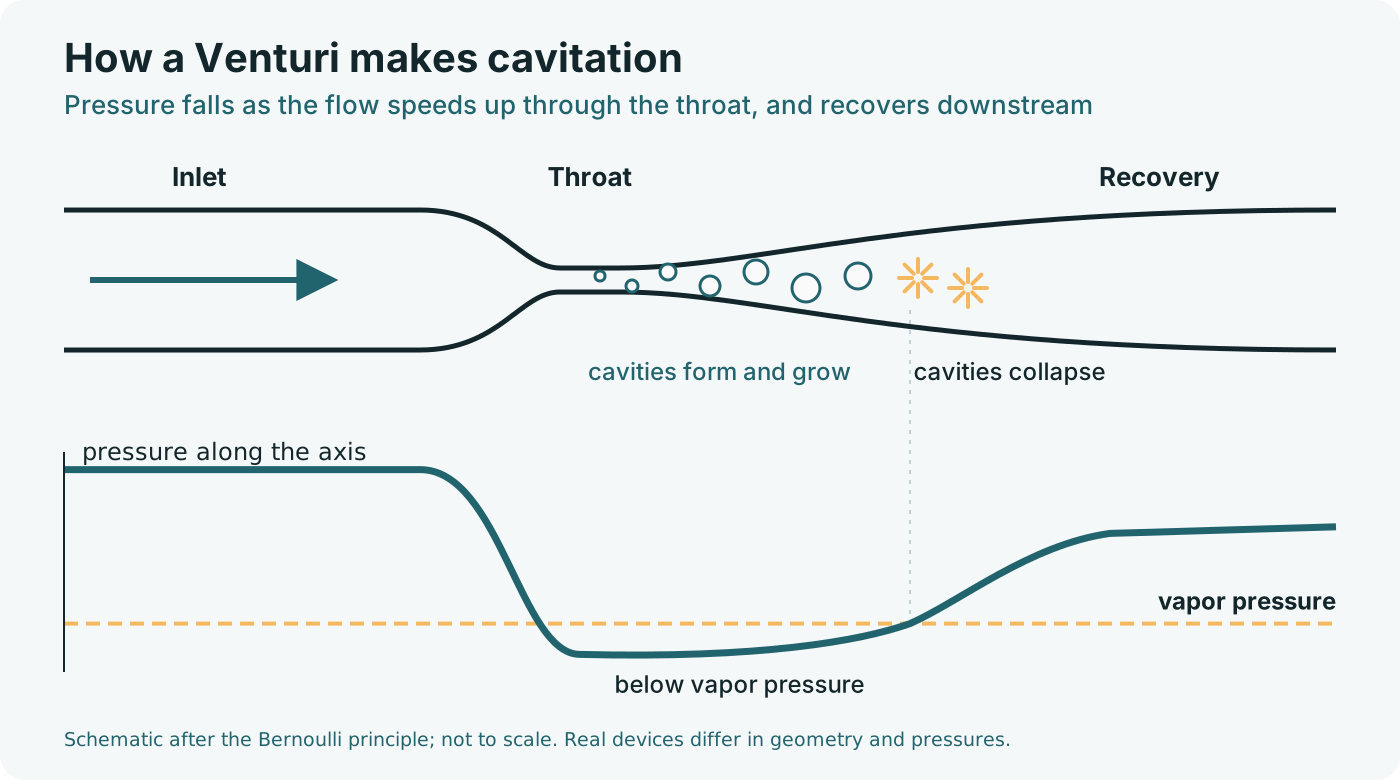
By Bernoulli's principle, a constriction that speeds water up also lowers its static pressure, so a narrow throat creates a low-pressure zone Zheng et al., 2022. Unlike boiling, no heating is involved: the pressure falls while the liquid temperature stays the same Krella, 2023. The bulk of the water stays near ambient conditions; cavitation exists only locally Carpenter et al., 2017.
Real water cavitates far more easily than pure water would. According to a review of nucleation research, the tensile strength of tap water or seawater (the tension it bears before it tears) is typically well below 1 bar. That limit is set by cavitation nuclei: tiny gas bubbles in the water, or gas pockets on particles and walls Mørch, 2015.
Inception, growth and collapse
A cavity starts (inception) when a nucleus enters the low-pressure zone, grows while the pressure stays below vapor pressure, and collapses downstream, where the pressure recovers suddenly and releases a significant amount of energy. The lower the throat pressure, the more severe the cavitation Zheng et al., 2022. In a Venturi, cavities form and grow in the throat and collapse in the diverging section as pressure climbs back toward line pressure.
In simulations, hydrodynamic cavities grew and collapsed over longer time scales than ultrasonic ones, which hindered collapse and gave fewer cycles per unit time Arrojo & Benito, 2008. A review summarizes the difference: acoustic cavitation tends to give highly intense collapses, hydrodynamic cavitation many cavities of relatively low intensity Zheng et al., 2022.
The cavitation number, and why studies disagree about it
The compares the pressure that keeps a liquid intact with the kinetic energy of the flow:
σ = (p0 − pv) / (½ ρ v0²)
where p0 is a reference static pressure, pv the vapor pressure, ρ the density and v0 a reference velocity Zheng et al., 2022. Lower values mean cavitation is more likely or more intense. Bagal and Gogate reported inception near σ ≈ 1 and the best performance between 0.1 and 1.0, as reviewed by Zheng et al., 2022.
The number travels poorly between studies. Reported inception values ranged from well below 1 to more than 3, depending on conditions, geometry and nuclei. Groups also plug in different values: pressure and velocity downstream of the cavitation zone, at the throat, upstream or ambient. Using pressures and velocities measured at different points of one rig, Šarc and colleagues obtained cavitation numbers of roughly 1.2 to 168.0 for the same trials Zheng et al., 2022.
They concluded that the cavitation number cannot describe cavitation alone. Reports were inconsistent and often poorly repeatable; geometry, flow velocity, temperature and water quality all changed the size, dynamics and aggressiveness of cavitation Šarc et al., 2017.
Four device families
Reviews split HC devices into stationary types, with no moving parts, and rotational types Zheng et al., 2022.
- Venturi tube: converging inlet, throat and diverging cone; pressure changes gradually. In simulations, the diverging angle strongly affected where cavitation started and how far it extended; throat length mattered less Simpson & Ranade, 2018.
- Orifice plate: one or more holes in a plate; pressure changes abruptly, and a theoretical comparison found a larger pressure drop and more intense cavitation than in a Venturi Zheng et al., 2022.
- Vortex device: the water is spun into a strong vortex, and tangential forces generate cavitation Zheng et al., 2022. Researchers who scaled up vortex devices described them as less prone to clogging and erosion than constrictions Ranade et al., 2021.
- Rotor–stator device: a rotor with holes or teeth turns inside a housing, and cavitation forms between shear layers moving in opposite directions. It avoids the pressure fluctuations of stationary devices, but moving parts need frequent maintenance Zheng et al., 2022. A laboratory unit produced intense shear and several cavitation zones while refining paper pulp Kosel et al., 2019.
Which family is best depends on the metric. On potassium iodide oxidation, an orifice gave the highest yield per unit energy among four devices, and bubble clouds lowered the Venturis' yield Pawar et al., 2017. A review states that industry prefers Venturis for lower energy use and greater bubble generation Zheng et al., 2022. With coumarin at 200 kPa, a vortex device led on removal per watt De-Nasri et al., 2022. Each ranking holds for its own measure, chemical and operating point.
Hydrodynamic and acoustic cavitation: energy and scale-up
Acoustic cavitation uses ultrasound from a probe or bath; HC uses a pump and a device in a pipe, and unlike ultrasound it has been used at large industrial scale Ranade et al., 2021. Comparing both on one model reaction, a pilot-scale orifice plate was the most energy-efficient setup Gogate et al., 2001. For nanoemulsions, HC was reported 11 times more energy efficient, in work by Carpenter and colleagues reviewed by Zheng et al., 2022. Cost comparisons are in Combining gases and cavitation.
Scale-up is less settled. The authors of the first systematic scale-up study noted that reviews call it "relatively easy" without evidence. They tested four similar vortex devices, with throats of 3 to 38 mm, at a 280 kPa pressure drop on 2,4-dichloroaniline. Degradation per pass fell as devices grew, then leveled off; the smallest device gave the most degradation per unit energy Ranade et al., 2021.
Cavitation erosion
The same collapse damages hydraulic machines, propellers and valves. Near a wall, a collapsing cavity drives a jet of liquid (a micro-jet) against the surface and emits shock waves; where the impact pressure exceeded a material threshold such as the yield stress, damage followed. Reported micro-jet velocities ranged from 30 to 877 m/s. Erosion typically passes through incubation, acceleration and deceleration periods, and resistance correlated with hardness, though ductility, fatigue strength and toughness also mattered Krella, 2023. Venturi and orifice devices are also prone to erosion and clogging Ranade et al., 2021.
What this means in practice
Describe a cavitation device by its operating conditions, not by one number. Record inlet and downstream pressure, flow rate and throat velocity, water temperature, dissolved gas and geometry, the variables that changed cavitation in the repeatability study Šarc et al., 2017. When a cavitation number is quoted, ask which pressure and velocity it uses. Compare devices in the same water, on the result you need, per pass and per kilowatt-hour of pumping energy, and confirm bench results at the intended scale Ranade et al., 2021. Inspect constrictions and rotors for wear and deposits.
Limits and open questions
- Most evidence is laboratory or pilot scale with model chemicals, so device rankings may not transfer to other targets or process water.
- The cavitation-number figures and the 11-fold nanoemulsion comparison come from a review; the primary studies were not available in full.
- Device comparisons were made at single operating points, and only one systematic scale-up study was found.
- Erosion figures come from materials test rigs and show mechanisms, not the service life of a device.
Questions
Is cavitation the same as boiling?
No. Both produce vapor, but boiling raises the temperature until the vapor pressure exceeds the surrounding pressure, while cavitation lowers the local pressure below the vapor pressure at constant temperature. In hydrodynamic cavitation the bulk water stays near ambient temperature; cavities form only where the flow is fast.
What cavitation number should a device run at?
There is no single value. A review reported inception numbers from well below 1 to above 3, and one study found the best performance between 0.1 and 1.0. The number also depends on the pressure and velocity used: one group calculated 1.2 to 168.0 for the same trials.
Is hydrodynamic cavitation more efficient than ultrasound?
In the comparisons cited here, it was: a pilot-scale orifice plate was the most energy-efficient device on one model reaction, and hydrodynamic cavitation was reported 11 times more efficient for nanoemulsions. Efficiency per unit energy fell as vortex devices were scaled up, however, so bench results need checking at scale.
References
- Mørch, K. A. (2015). Cavitation inception from bubble nuclei. Interface Focus, 5, 20150006. https://doi.org/10.1098/rsfs.2015.0006 ↩
- Zheng, H., Zheng, Y., Zhu, J. (2022). Recent Developments in Hydrodynamic Cavitation Reactors: Cavitation Mechanism, Reactor Design, and Applications. Engineering, 19, 180-198. https://doi.org/10.1016/j.eng.2022.04.027 ↩
- De-Nasri, S. J., Sarvothaman, V. P., Nagarajan, S., et al. (2022). Quantifying OH radical generation in hydrodynamic cavitation via coumarin dosimetry: Influence of operating parameters and cavitation devices. Ultrasonics Sonochemistry, 90, 106207. https://doi.org/10.1016/j.ultsonch.2022.106207 ↩
- Pawar, S. K., Mahulkar, A. V., Pandit, A. B., et al. (2017). Sonochemical effect induced by hydrodynamic cavitation: Comparison of venturi/orifice flow geometries. AIChE Journal, 63, 4705-4716. https://doi.org/10.1002/aic.15812 ↩
- Ranade, V. V., Prasad Sarvothaman, V., Simpson, A., et al. (2021). Scale-up of vortex based hydrodynamic cavitation devices: A case of degradation of di-chloro aniline in water. Ultrasonics Sonochemistry, 70, 105295. https://doi.org/10.1016/j.ultsonch.2020.105295 ↩
- Krella, A. K. (2023). Degradation and Protection of Materials from Cavitation Erosion: A Review. Materials, 16, 2058. https://doi.org/10.3390/ma16052058 ↩
- Carpenter, J., Badve, M., Rajoriya, S., et al. (2017). Hydrodynamic cavitation: an emerging technology for the intensification of various chemical and physical processes in a chemical process industry. Reviews in Chemical Engineering, 33. https://doi.org/10.1515/revce-2016-0032 ↩
- Arrojo, S., Benito, Y. (2008). A theoretical study of hydrodynamic cavitation. Ultrasonics Sonochemistry, 15, 203-211. https://doi.org/10.1016/j.ultsonch.2007.03.007 ↩
- Šarc, A., Stepišnik-Perdih, T., Petkovšek, M., et al. (2017). The issue of cavitation number value in studies of water treatment by hydrodynamic cavitation. Ultrasonics Sonochemistry, 34, 51-59. https://doi.org/10.1016/j.ultsonch.2016.05.020 ↩
- Simpson, A., Ranade, V. V. (2018). Modeling hydrodynamic cavitation in venturi: influence of venturi configuration on inception and extent of cavitation. AIChE Journal, 65, 421-433. https://doi.org/10.1002/aic.16411 ↩
- Kosel, J., Šinkovec, A., Dular, M. (2019). A novel rotation generator of hydrodynamic cavitation for the fibrillation of long conifer fibers in paper production. Ultrasonics Sonochemistry, 59, 104721. https://doi.org/10.1016/j.ultsonch.2019.104721 ↩
- Gogate, P. R., Shirgaonkar, I. Z., Sivakumar, M., et al. (2001). Cavitation reactors: Efficiency assessment using a model reaction. AIChE Journal, 47, 2526-2538. https://doi.org/10.1002/aic.690471115 ↩