Nanobubbles in wound-healing research
What have studies and reviews reported about oxygen nanobubbles and chronic wounds?
On this page
Oxygen delivery to hypoxic wounds
A review proposed micro- and nanobubbles as a way to get dissolved oxygen into chronic wounds, where the tissue is short of oxygen and conventional topical oxygen reaches it poorly Sayadi et al., 2018.
Chronic wounds, such as diabetic foot ulcers and venous stasis ulcers, have a persistently hypoxic microenvironment (pO₂ below 30 mmHg) that holds repair in the inflammatory phase. Topical gaseous oxygen has a major limitation: it penetrates poorly through the liquid exudate and dead tissue (slough) that cover the wound bed Sayadi et al., 2018.
How nanobubbles are proposed to help
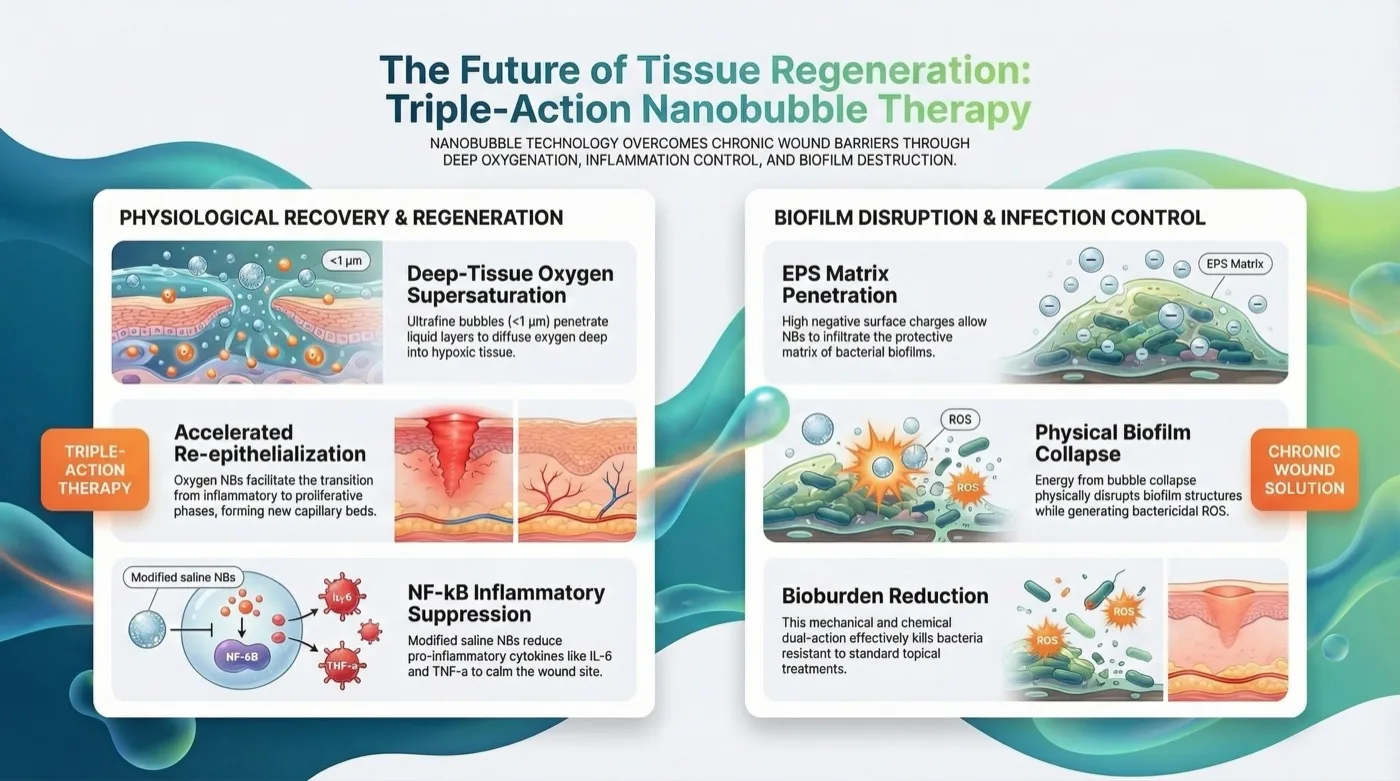
Nanobubbles offer a way to deliver oxygen already dissolved in liquid. Because they are smaller than 1 µm, they are proposed to pass through the liquid boundary layer and diffuse into the tissue below. Their high internal pressure, described by the Young–Laplace equation, makes them dense reservoirs of gas that can supersaturate wound fluid and keep the partial pressure of oxygen (pO₂) high for longer than conventional aeration Sayadi et al., 2018.
The related animal evidence is indirect. Ebina et al. reported that water containing oxygen nanobubbles promoted growth, measured as weight and length, in mice and fish. That was growth in healthy animals, not wound closure, so any link to tissue repair is an inference that has not been tested in the work cited here Ebina et al., 2013.
Collagen, new blood vessels and the move out of inflammation
Oxygen is a required cofactor for building collagen and new blood vessels, and the review argued that relieving hypoxia helps a wound move from the inflammatory phase into the proliferative phase Sayadi et al., 2018.
The mechanism is biochemical. Adequate oxygen is needed to hydroxylate proline and lysine residues in procollagen, a step collagen needs to cross-link and give a wound its tensile strength. Oxygen also regulates vascular endothelial growth factor (VEGF), which drives new capillary growth. By reversing hypoxia, the review proposed, oxygen delivered by nanobubbles could support re-epithelialization and the formation of new capillary beds Sayadi et al., 2018.
Hypoxia signaling and wound-bed enzymes
The review also described effects on two signaling systems that stall chronic wounds: the hypoxia response and the balance of tissue-remodeling enzymes Sayadi et al., 2018.
Hypoxia stabilizes hypoxia-inducible factor 1-alpha (HIF-1α). In a chronic wound, this factor stays active for too long, which keeps the tissue's hypoxic drive switched on. According to the review, delivering oxygen directly to hypoxic tissue with micro- and nanobubbles lowers HIF-1α signaling toward normal levels while supporting the metabolic pathways growth factors such as IGF-1 and VEGF depend on Sayadi et al., 2018.
The same review linked oxygen delivery to the balance between matrix metalloproteinases (MMPs), enzymes that break down tissue, and tissue inhibitors of metalloproteinases (TIMPs), which hold them in check. Restoring that balance matters for collagen deposition and re-epithelialization. The review also proposed that micro- and nanobubbles are small enough to reach the wound bed through the biofilm layers that block conventional oxygen Sayadi et al., 2018. These are mechanisms described in a review, not results from a wound trial.
Biofilm and bacterial load
Bacterial biofilms are a main reason chronic wounds stay open, and nanobubbles have been proposed as a way to disrupt them; the direct evidence cited here comes from ozone nanobubble water in the mouth, not from wounds Sayadi et al., 2018; Hayakumo et al., 2012.
Biofilms consume the available oxygen and form a physical barrier against antibiotics and immune cells. The proposed mechanism has two parts. Nanobubbles carry a strongly negative surface charge () and are reported to generate (reactive oxygen species) when they collapse, properties said to let them penetrate the extracellular polymeric substance (EPS) matrix of a biofilm. Once inside, the physical energy of collapse (shock waves) and the oxidizing power of the gas, especially when ozone nanobubbles are used, could disrupt the biofilm structure and lower bacterial counts.
The clinical data point to the mouth. In periodontitis patients, irrigation with ozone nanobubble water alongside mechanical cleaning reduced total bacterial counts in dental plaque Hayakumo et al., 2012. Whether the same holds in a chronic wound, with different bacteria and tissue, has not been studied in the work summarized here. The oral research is covered in Nanobubbles in oral-health research.
Limits and open questions
This is early-stage research. The mechanisms in this lesson come mainly from a single review of topical oxygen and micro/nanobubbles, not from controlled wound trials, and no randomized trial of nanobubbles in human chronic wounds is cited.
The animal evidence measured growth in healthy mice and fish, not wound closure, and the biofilm evidence comes from ozone nanobubble water in periodontal patients, whose bacteria and tissues differ from those of chronic wounds. The lesson gives no sample sizes, doses or treatment durations.
The link between nanobubbles and inflammation-related signaling rests on the review's reasoning, not on measurements in wounds. Safety, dosing and long-term effects of any nanobubble wound product in people are not established by the work summarized here.
References
- Sayadi, L. R., Banyard, D. A., Ziegler, M. E., et al. (2018). Topical oxygen therapy & micro/nanobubbles: a new modality for tissue oxygen delivery. International Wound Journal, 15, 363-374. https://doi.org/10.1111/iwj.12873 ↩
- Ebina, K., Shi, K., Hirao, M., et al. (2013). Oxygen and Air Nanobubble Water Solution Promote the Growth of Plants, Fishes, and Mice. PLoS ONE, 8, e65339. https://doi.org/10.1371/journal.pone.0065339 ↩
- Hayakumo, S., Arakawa, S., Mano, Y., et al. (2012). Clinical and microbiological effects of ozone nano-bubble water irrigation as an adjunct to mechanical subgingival debridement in periodontitis patients in a randomized controlled trial. Clinical Oral Investigations, 17, 379-388. https://doi.org/10.1007/s00784-012-0711-7 ↩