Hydroponics and soilless culture
What does dissolved oxygen do in a nutrient solution, and how do nanobubbles hold it there?
On this page
- Key takeaways
- Nanobubbles held dissolved oxygen in solution for weeks
- Warm solutions hold less oxygen
- Root health: dissolved oxygen and root-zone pathogens
- Biofilm in lines and reservoirs
- Ozone is a separate tool
- Growth results in soilless systems
- What this means in practice
- Limits and open questions
- Questions
- References
Nanobubbles held dissolved oxygen in solution for weeks
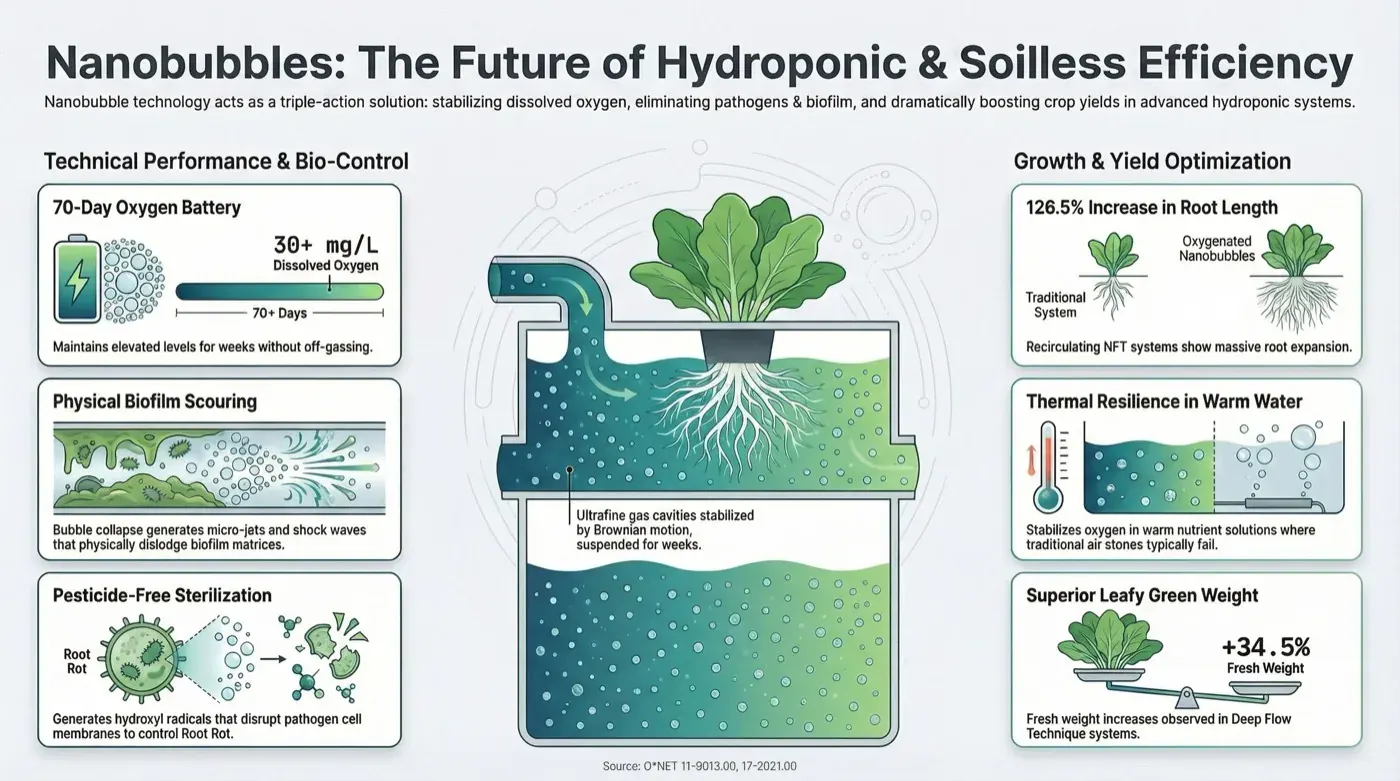
Oxygen nanobubble water raised dissolved oxygen () from about 8 mg/L to more than 30 mg/L and kept it elevated for up to 70 days in trials reported by Ebina et al., 2013. In a hydroponic reservoir, the aim is to make the solution itself a store of oxygen for the roots.
The difference lies in bubble size. Air stones produce macrobubbles and (1–100 µm) that rise quickly to the surface and burst, so gas transfer is inefficient and each bubble stays in the solution only briefly. (below 200 nm) have negligible buoyancy and move by Brownian motion, and were reported to stay suspended for weeks or months without off-gassing Ebina et al., 2013.
The 70-day figure describes the conditions of that study. A working system, with roots consuming oxygen, open channels and changing temperature, is a different setting, and DO has to be measured where the roots are.
Warm solutions hold less oxygen
Oxygen solubility falls as water warms (Henry's law), so nutrient solutions in warm greenhouses carry less DO just when roots respire fastest. The result can be in the root zone.
A review describes nanobubbles as a promising way to retain DO in outdoor hydroponics in hot climates, where conventional aeration struggles to keep oxygen adequate Foudas et al., 2023. This is a review's assessment; the lesson cites no measured comparison of DO against temperature.
Root health: dissolved oxygen and root-zone pathogens
Oxygen in the nutrient solution supports root health, and a review links it to lower susceptibility to root pathogens Mamun & Islam, 2025. Plants kept at high DO (6.6–7.4 mg/L) were less susceptible to Phytophthora than plants at low oxygen (below 1 mg/L). In hydroponic tomato, oxygen supplied by bubbling reduced Pythium colonization of the roots.
Oomycetes such as Pythium and Phytophthora thrive in stagnant, hypoxic zones. The review attributes the effect of oxygen to roots that can sustain their own defenses, to conditions less favorable to the pathogens' swimming spores (zoospores), and to aerobic conditions that favor beneficial microbes. It proposes that nanobubbles, by holding DO high, would extend this effect Mamun & Islam, 2025.
The Pythium result involved oxygen delivered by bubbling, not nanobubbles specifically, and both results come through a review. Dissolved oxygen is one root-zone condition among several; it does not replace sanitation, clean water or an integrated pest management program.
Biofilm in lines and reservoirs
Nanobubbles have been studied as a way to limit biofouling in agricultural water distribution systems Xiao et al., 2020. Biofilm in pipes and emitters can harbor microbes and clog the lines that deliver nutrient solution.
Two mechanisms are proposed. Physically, nanobubbles create shear at the liquid–solid interface, and their oscillation and collapse are thought to produce micro-jets that dislodge extracellular polymeric substances (EPS) and detach biofilm from pipe walls Babu & Amamcharla, 2022; Xiao et al., 2021. Chemically, bubble collapse is thought to generate low levels of reactive oxygen species (), including hydroxyl radicals (•OH), which degrade the proteins and polysaccharides of the biofilm matrix and damage bacterial cell membranes Shiroodi et al., 2021; Xiao et al., 2020.
These mechanisms come from a biological aerated filter study, a review and tests on food-contact surfaces, not from hydroponic roots. Roots also carry beneficial microbial films, so line hygiene and root health are separate goals.
Ozone is a separate tool
Ozone is an oxidant, not a source of oxygen for roots, and its use in nutrient solutions is a different decision from oxygenation. Tamaki et al. studied how hydroponic leaf lettuce and komatsuna grew when the nutrient solution received ozone microbubble treatment Tamaki et al., 2020. Whether plants are harmed depends on the dose, so ozone treatment needs dose control and monitoring of its own.
Growth results in soilless systems
Air nanobubble treatment increased the aerial fresh weight of Brassica campestris by 27% to 34.5% compared with controls using standard aeration, with gains in plant height and leaf length as well Ebina et al., 2013.
In recirculating NFT systems, oxygen nanobubbles were associated with a 126.5% increase in root length, a figure reported in a review Mamun & Islam, 2025. A larger root system has more surface for nutrient uptake.
In deep flow technique (DFT) culture, microbubbles promoted lettuce growth by increasing uptake of dissolved nutrient ions, across the electrical conductivity (EC) levels tested Park & Kurata, 2009; Foudas et al., 2023.
What this means in practice
These findings are most relevant where DO is likely to run short: recirculating NFT and DFT systems, warm nutrient solutions, dense root masses and long channels where oxygen falls between inlet and outlet.
What to measure: DO in mg/L and solution temperature at the reservoir and at the root zone at the far end of channels, logged through the day; EC and pH; root color and root mass at harvest; and fresh weight per plant. If ozone is used, add oxidation-reduction potential (), dissolved ozone and a check for plant injury.
How to test it: run matched channels or systems with the same recipe and climate, one with nanobubble oxygenation and one with the current aeration, and compare DO profiles, root mass and fresh weight over several crop cycles. Keep the cleaning, water treatment and pest management program the same in both; oxygen supports root health, and it does not replace sanitation.
Limits and open questions
- The DO retention figures (above 30 mg/L, up to 70 days) come from one study's conditions, not from a working hydroponic system with plants drawing oxygen.
- The Phytophthora, Pythium and 126.5% root-length figures come from a review; the lesson does not cite the original trials.
- The Pythium result involved oxygen delivered by bubbling, not nanobubbles specifically.
- Biofilm mechanisms come from a filter study, a review and food-contact surfaces, not from hydroponic roots.
- The ozone study measured plant growth responses; this lesson reports no pathogen outcome for ozone.
- The warm-climate benefit is a review's assessment, without a measured DO-temperature comparison here.
Questions
How long do nanobubbles keep a nutrient solution oxygenated?
In trials reported by Ebina et al. (2013), oxygen nanobubble water held DO above 30 mg/L, from a starting point of about 8 mg/L, for up to 70 days. In a working system, roots, temperature and circulation all pull DO down, so measure it at the roots.
Can oxygen nanobubbles replace sanitation in a hydroponic system?
No. The research here links higher DO with lower susceptibility to Phytophthora and less Pythium colonization, which supports root health. It does not show that oxygen keeps a system clean. Keep the cleaning, water treatment and pest management program, and manage DO as one root-zone condition.
Is ozone the same as oxygen nanobubbles?
No. Oxygen supports root respiration; ozone is a strong oxidant. Tamaki et al. (2020) studied how hydroponic lettuce and komatsuna grew with ozone microbubble treatment of the solution. Whether plants are harmed depends on the dose, so ozone needs its own dose control and monitoring.
References
- Ebina, K., Shi, K., Hirao, M., et al. (2013). Oxygen and Air Nanobubble Water Solution Promote the Growth of Plants, Fishes, and Mice. PLoS ONE, 8, e65339. https://doi.org/10.1371/journal.pone.0065339 ↩
- Mamun, M. A., Islam, T. (2025). Oxygenated Nanobubbles as a Sustainable Strategy to Strengthen Plant Health in Controlled Environment Agriculture. Sustainability, 17, 5275. https://doi.org/10.3390/su17125275 ↩
- Park, J. S., Kurata, K. (2009). Application of Microbubbles to Hydroponics Solution Promotes Lettuce Growth. HortTechnology, 19, 212-215. https://doi.org/10.21273/HORTSCI.19.1.212 ↩
- Foudas, A. W., Kosheleva, R. I., Favvas, E. P., et al. (2023). Fundamentals and applications of nanobubbles: A review. Chemical Engineering Research and Design, 189, 64-86. https://doi.org/10.1016/j.cherd.2022.11.013 ↩
- Xiao, Y., Jiang, S. C., Wang, X., et al. (2020). Mitigation of biofouling in agricultural water distribution systems with nanobubbles. Environment International, 141, 105787. https://doi.org/10.1016/j.envint.2020.105787 ↩
- Babu, K. S., Amamcharla, J. K. (2022). Generation methods, stability, detection techniques, and applications of bulk nanobubbles in agro-food industries: a review and future perspective. Critical Reviews in Food Science and Nutrition, 63, 9262-9281. https://doi.org/10.1080/10408398.2022.2067119 ↩
- Xiao, W., Xu, G., Li, G. (2021). Role of shear stress in biological aerated filter with nanobubble aeration: Performance, biofilm structure and microbial community. Bioresource Technology, 325, 124714. https://doi.org/10.1016/j.biortech.2021.124714 ↩
- Shiroodi, S., Schwarz, M. H., Nitin, N., et al. (2021). Efficacy of Nanobubbles Alone or in Combination with Neutral Electrolyzed Water in Removing Escherichia coli O157:H7, Vibrio parahaemolyticus, and Listeria innocua Biofilms. Food and Bioprocess Technology, 14, 287-297. https://doi.org/10.1007/s11947-020-02572-0 ↩
- Tamaki, M., Ikeura, H., Enmei, N. (2020). Growth response of hydroponic leaf lettuce and komatsuna to ozone microbubble treatment. Journal of Plant Nutrition, 43, 1369-1377. https://doi.org/10.1080/01904167.2020.1730896 ↩