Nitrogen nanobubbles (N₂)
What can an inert gas do as a nanobubble?
On this page
What nitrogen nanobubbles do
Nitrogen nanobubbles change how surfaces interact without oxidizing them. Nitrogen is chemically inert, so its bubbles can attach to particles, line pore walls or seed crystals without the oxidative side effects of air or oxygen. That makes them useful where oxygen is unwanted: sulfide flotation, hydrocarbon extraction and oxygen-sensitive foods.
Mining: flotation of fine and sulfide particles
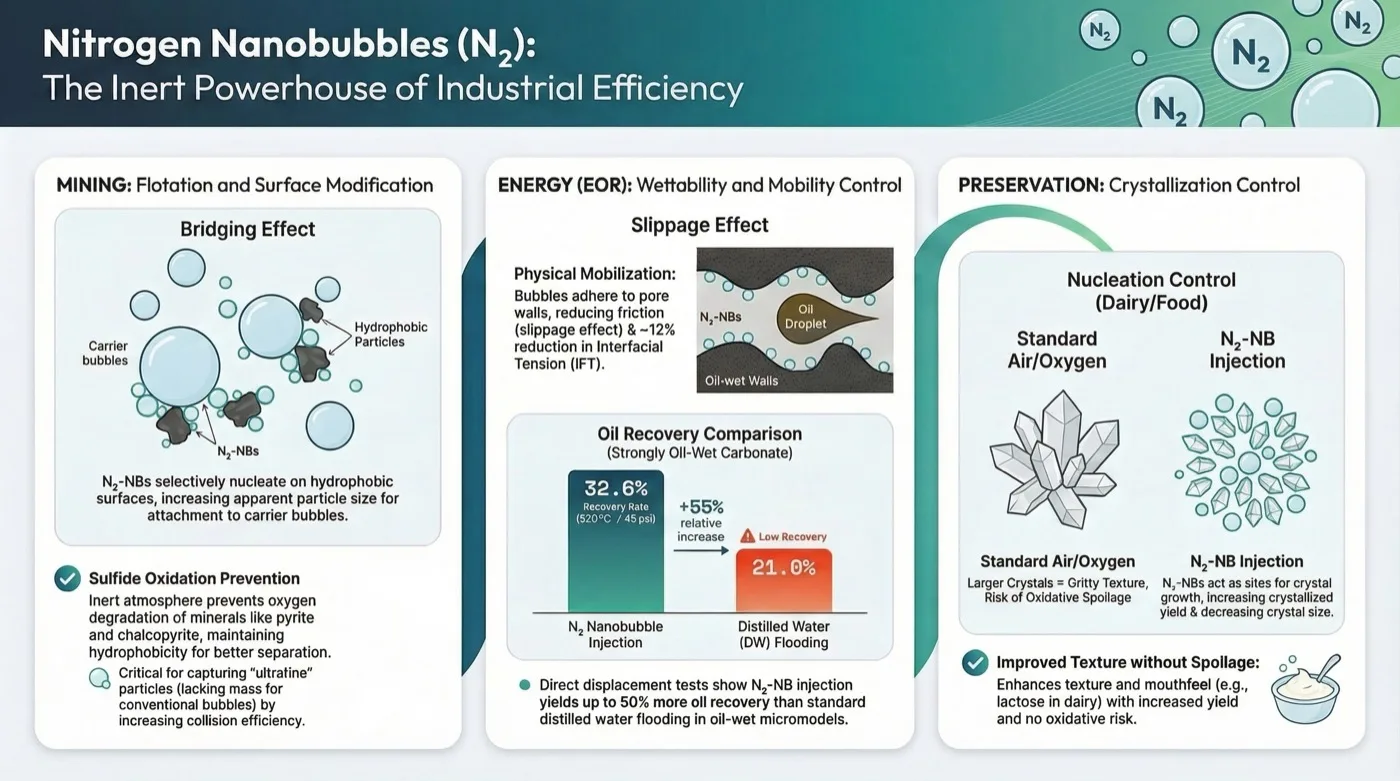
In froth flotation, N₂-NBs nucleate selectively on hydrophobic mineral surfaces and act as a secondary collector. This "bridging" effect increases the apparent particle size and hydrophobicity, so particles attach more readily to larger carrier bubbles. It matters most for fine and ultrafine particles, which are usually recovered poorly because they rarely collide with bubbles Tao, 2022; Azevedo et al., 2019.
Air is the usual flotation gas, but its oxygen can oxidize sulfide minerals such as pyrite and chalcopyrite and reduce flotation selectivity. N₂-NBs provide an inert atmosphere that limits this surface oxidation, helping sulfide minerals keep their natural hydrophobicity and improving separation in complex ores Kyzas et al., 2021.
Oil recovery: wettability and slippage
In high-pressure micromodel studies, N₂-NBs improved oil recovery from oil-wet pores mainly through physical mechanisms. They lowered interfacial tension (IFT) by about 12%, and bubbles adhering to pore walls produced a slippage effect that reduced friction and helped mobilize oil. In direct displacement tests, N₂-NB injection recovered up to 50% more oil than conventional water flooding in oil-wet scenarios Taman et al., 2025.
Spontaneous imbibition tests gave a similar picture. On strongly oil-wet carbonate rock at 120 °C and 45 psi, N₂-NB solutions reached an ultimate oil recovery of 32.6%, against 21% for distilled water. That result came close to the recovery observed in water-wet rock Elnaggar et al., 2025.
Food processing: crystallization
In food processing, N₂-NBs have been studied to control crystallization and limit oxidative spoilage. Adding nitrogen nanobubbles improved lactose crystal nucleation, increasing the crystallized yield while reducing crystal size, which improved the texture of dairy products without introducing reactive oxygen Babu & Amamcharla, 2023.
How nitrogen compares with other gases
Nitrogen is chosen when oxygen would do harm. Against air and oxygen, its advantage is that it does not oxidize mineral or food surfaces. Against carbon dioxide in oil recovery, it works differently: CO₂ nanobubbles dissolve into crude oil, swelling it and lowering its viscosity Cai et al., 2024, while nitrogen acted mainly through interfacial tension and slippage. Side-by-side results are collected in Combining gases and cavitation.
Limits and open questions
- The oil-recovery figures come from laboratory imbibition and micromodel tests, not from reservoir field trials.
- The 32.6% result applies to one set of conditions: strongly oil-wet carbonate rock at 120 °C and 45 psi.
- The flotation mechanism comes from reviews of nanobubble flotation in general; this profile gives no nitrogen-specific recovery figures for ores.
- Nitrogen nanobubbles were described as a secondary collector, working alongside flotation reagents, not replacing them.
- The lactose result comes from a review of nanobubbles in agro-food industries.
Questions
Why use nitrogen instead of air in flotation?
Oxygen in air can oxidize the surfaces of sulfide minerals such as pyrite and chalcopyrite, which reduces flotation selectivity. Nitrogen is inert, so nitrogen nanobubbles supply bubbles without that oxidation and help the minerals keep their natural hydrophobicity. They work alongside flotation reagents, not instead of them.
How much extra oil did nitrogen nanobubbles recover?
In spontaneous imbibition tests on strongly oil-wet carbonate rock at 120 °C and 45 psi, nitrogen nanobubble solutions recovered 32.6% of the oil, compared with 21% for distilled water. In micromodels, recovery was up to 50% higher than with water flooding. Both are laboratory results.
How do nitrogen nanobubbles differ from CO₂ in oil recovery?
CO₂ nanobubbles dissolve into crude oil, which swells it and lowers its viscosity. In micromodel studies, nitrogen nanobubbles worked mainly through physical effects: about 12% lower interfacial tension and a slippage effect as bubbles adhered to pore walls, which reduced friction and helped mobilize the oil.
References
- Elnaggar, H., Taman, A., Ali, R., et al. (2025). Oil Recovery Enhancement by N 2 Nanobubbles. Energy & Fuels, 39, 2482-2499. https://doi.org/10.1021/acs.energyfuels.4c05180 ↩
- Taman, A., Shoukry, A. E., Kubelka, J., et al. (2025). Oil Recovery Enhancement by Nanobubbles: Insights from High-Pressure Micromodel Studies. Journal of Colloid and Interface Science, 693, 137647. https://doi.org/10.1016/j.jcis.2025.137647 ↩
- Kyzas, G. Z., Mitropoulos, A. C., Matis, K. A. (2021). From Microbubbles to Nanobubbles: Effect on Flotation. Processes, 9, 1287. https://doi.org/10.3390/pr9081287 ↩
- Babu, K. S., Amamcharla, J. K. (2022). Generation methods, stability, detection techniques, and applications of bulk nanobubbles in agro-food industries: a review and future perspective. Critical Reviews in Food Science and Nutrition, 63, 9262-9281. https://doi.org/10.1080/10408398.2022.2067119 ↩
- Tao, D. (2022). Recent advances in fundamentals and applications of nanobubble enhanced froth flotation: A review. Minerals Engineering, 183, 107554. https://doi.org/10.1016/j.mineng.2022.107554 ↩
- Azevedo, A., Oliveira, H., Rubio, J. (2019). Bulk nanobubbles in the mineral and environmental areas: Updating research and applications. Advances in Colloid and Interface Science, 271, 101992. https://doi.org/10.1016/j.cis.2019.101992 ↩
- Cai, L., Wu, J., Zhang, M., et al. (2024). Investigating the Potential of CO2 Nanobubble Systems for Enhanced Oil Recovery in Extra-Low-Permeability Reservoirs. Nanomaterials, 14, 1280. https://doi.org/10.3390/nano14151280 ↩