Oxygen nanobubbles (O₂)
What do oxygen nanobubbles do, and where have researchers tested them?
On this page
What oxygen nanobubbles do
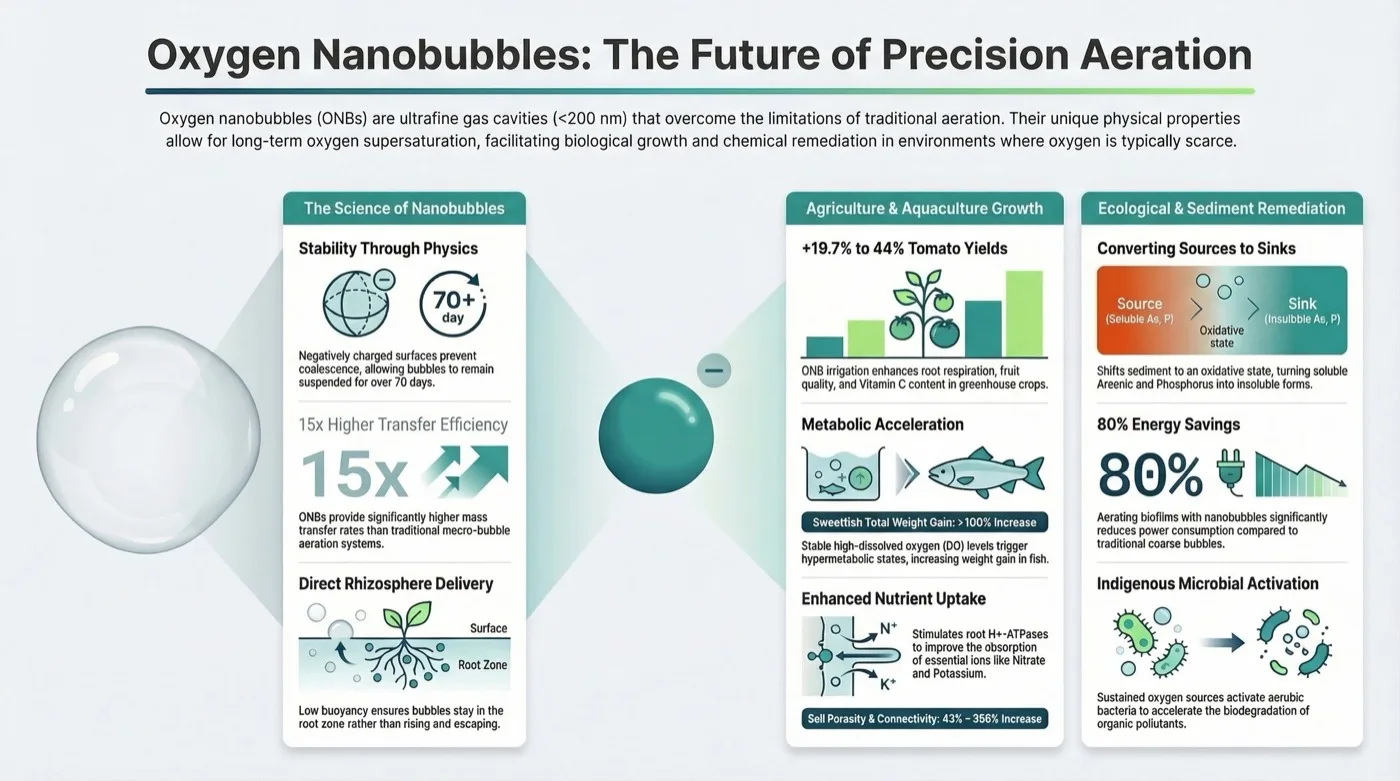
Oxygen nanobubbles are used to get oxygen into water faster and keep it there longer. Their main job is to overcome the mass-transfer limits of ordinary aeration and hold (dissolved oxygen) above saturation for extended periods, which supports aerobic biological processes.
Two properties make this possible: low buoyancy and high internal pressure. Because of them, ONBs stay suspended in the soil solution instead of rising and escaping, and carry oxygen with the irrigation water to the Wang et al., 2021; Baram et al., 2022.
Crops: root-zone oxygen and yield
In heavy, saline or flooded soils, limits root respiration. Researchers reported that ONBs relieved this stress, increased root activity and improved nutrient uptake. In rice, the effect was linked to up-regulated nutrient-transport genes Wang et al., 2021. Drip irrigation with nanobubble-oxygenated treated wastewater improved soil aeration Baram et al., 2022.
Root health also depends on soil life. In one study, oxygenated nanobubble irrigation shifted the soil microbial community toward beneficial bacteria, and the authors linked this to better soil structure and higher crop production Chen et al., 2023.
Yield results so far come from individual crops:
- Tomato: yield about 19.7% above conventional irrigation, with higher vitamin C and soluble sugar content Lei et al., 2023; Liu et al., 2019.
- Lettuce: in hydroponics, ultrafine bubbles increased leaf area and fresh weight, easing the oxygen limits common in static solution culture Kobayashi & Yamaji, 2022; Ebina et al., 2013.
Aquaculture: fish growth
In one set of trials, sweetfish and rainbow trout kept in ONB water gained more total weight than fish under normal aeration Ebina et al., 2013. The proposed explanation is a steadier supply of dissolved oxygen supporting metabolism and growth. The same paper tested oxygen and air nanobubble water.
Sediments and eutrophic water
ONBs placed at the sediment–water interface shifted its redox potential toward an oxidizing state. Under those conditions, soluble arsenic and phosphorus were converted to insoluble forms and less of them was released to the water column Tang et al., 2021. Minerals loaded with ONBs also reduced the transfer of arsenic from paddy soil to rice Sha et al., 2020.
In eutrophic water, surface ONBs supplied oxygen to indigenous aerobic microbes. Researchers reported faster breakdown of organic matter and lower production of anaerobic by-products such as methane Shi et al., 2018. A preliminary study used ONB-modified clay to counter hypoxia and anoxia at the sediment–water interface Zhang et al., 2018.
How oxygen compares with other gases
Oxygen is the gas to choose when the goal is respiration: roots, fish or aerobic microbes. Air nanobubbles cost less to produce and are often studied where pure oxygen is not needed. Ozone is chosen for oxidation of pollutants, and nitrogen where oxygen must be kept out.
Limits and open questions
- Each yield figure comes from specific crops and growing conditions; tomato and lettuce results may not transfer to other crops or growing systems.
- This profile does not report the dissolved oxygen levels, bubble sizes or doses behind each result, so the findings cannot be converted into a dose for a site.
- Some plant results used air or unspecified ultrafine bubbles rather than pure oxygen Kobayashi & Yamaji, 2022; Ebina et al., 2013.
- The fish results come from trials against normal aeration; they do not show performance at commercial stocking densities.
- Sediment work includes preliminary and small-scale studies Zhang et al., 2018.
- Dissolved oxygen supports root health and aerobic biology; it does not replace sanitation or water-quality management.
Questions
Do oxygen nanobubbles raise crop yield?
In the studies cited here, tomato yield was about 19.7% higher with oxygen nanobubble irrigation than with conventional irrigation, and fruit vitamin C and soluble sugars also rose. Results depend on crop, soil and baseline aeration, so a grower should compare treated and untreated blocks before drawing conclusions.
Why use oxygen instead of air?
Oxygen is chosen when the aim is to raise dissolved oxygen for roots, fish or aerobic microbes. Air nanobubbles cost less to produce, and reviews cited in the air profile describe them as often sufficient for soil aeration and basic water-quality work where pure oxygen is not justified.
Can oxygen nanobubbles help with polluted sediments?
In sediment studies, interfacial oxygen nanobubbles shifted the sediment–water interface toward oxidizing conditions and reduced arsenic and phosphorus release to the water. Oxygen-loaded minerals also reduced arsenic transfer from paddy soil to rice. These results come from specific sediments and study designs and may not transfer elsewhere.
References
- Lei, H., Wang, W., Liang, Y., et al. (2023). Effect of Nano-Bubble Irrigation on the Yield and Greenhouse Gas Warming Potential of Greenhouse Tomatoes. Agronomy, 13, 2917. https://doi.org/10.3390/agronomy13122917 ↩
- Liu, Y., Zhou, Y., Wang, T., et al. (2019). Micro-nano bubble water oxygation: Synergistically improving irrigation water use efficiency, crop yield and quality. Journal of Cleaner Production, 222, 835-843. https://doi.org/10.1016/j.jclepro.2019.02.208 ↩
- Wang, Y., Wang, S., Sun, J., et al. (2021). Nanobubbles promote nutrient utilization and plant growth in rice by upregulating nutrient uptake genes and stimulating growth hormone production. Science of The Total Environment, 800, 149627. https://doi.org/10.1016/j.scitotenv.2021.149627 ↩
- Ebina, K., Shi, K., Hirao, M., et al. (2013). Oxygen and Air Nanobubble Water Solution Promote the Growth of Plants, Fishes, and Mice. PLoS ONE, 8, e65339. https://doi.org/10.1371/journal.pone.0065339 ↩
- Tang, Y., Zhang, M., Zhang, J., et al. (2021). Reducing arsenic toxicity using the interfacial oxygen nanobubble technology for sediment remediation. Water Research, 205, 117657. https://doi.org/10.1016/j.watres.2021.117657 ↩
- Baram, S., Weinstein, M., Evans, J. F., et al. (2022). Drip irrigation with nanobubble oxygenated treated wastewater improves soil aeration. Scientia Horticulturae, 291, 110550. https://doi.org/10.1016/j.scienta.2021.110550 ↩
- Chen, W., Bastida, F., Liu, Y., et al. (2023). Nanobubble oxygenated increases crop production via soil structure improvement: The perspective of microbially mediated effects. Agricultural Water Management, 282, 108263. https://doi.org/10.1016/j.agwat.2023.108263 ↩
- Kobayashi, N., Yamaji, K. (2021). Leaf lettuce (Lactuca sativa L. ‘L-121’) growth in hydroponics with different nutrient solutions used to generate ultrafine bubbles. Journal of Plant Nutrition, 45, 816-827. https://doi.org/10.1080/01904167.2021.2006227 ↩
- Sha, Z., Chen, Z., Feng, Y., et al. (2020). Minerals loaded with oxygen nanobubbles mitigate arsenic translocation from paddy soils to rice. Journal of Hazardous Materials, 398, 122818. https://doi.org/10.1016/j.jhazmat.2020.122818 ↩
- Shi, W., Pan, G., Chen, Q., et al. (2018). Hypoxia Remediation and Methane Emission Manipulation Using Surface Oxygen Nanobubbles. Environmental Science & Technology, 52, 8712-8717. https://doi.org/10.1021/acs.est.8b02320 ↩
- Zhang, H., Lyu, T., Bi, L., et al. (2018). Combating hypoxia/anoxia at sediment-water interfaces: A preliminary study of oxygen nanobubble modified clay materials. Science of The Total Environment, 637-638, 550-560. https://doi.org/10.1016/j.scitotenv.2018.04.284 ↩