Nutrient use efficiency and yield
Can oxygenated irrigation help crops take up more of the fertilizer they are given?
On this page
- Key takeaways
- Yield and quality results by crop
- Nanobubbles may carry nutrient ions to the root surface
- Oxygen keeps the roots' nutrient pumps powered
- Nutrient-uptake genes were more active in rice
- Germination depended on the gas
- Reactive oxygen species act within a window
- What this means in practice
- Limits and open questions
- Questions
- References
Yield and quality results by crop
The strongest results in this lesson are yield and quality gains measured against non-aerated or conventionally irrigated controls. They come from different crops, systems and gases, so each is stated with its conditions.
Rice: yield and fertilizer
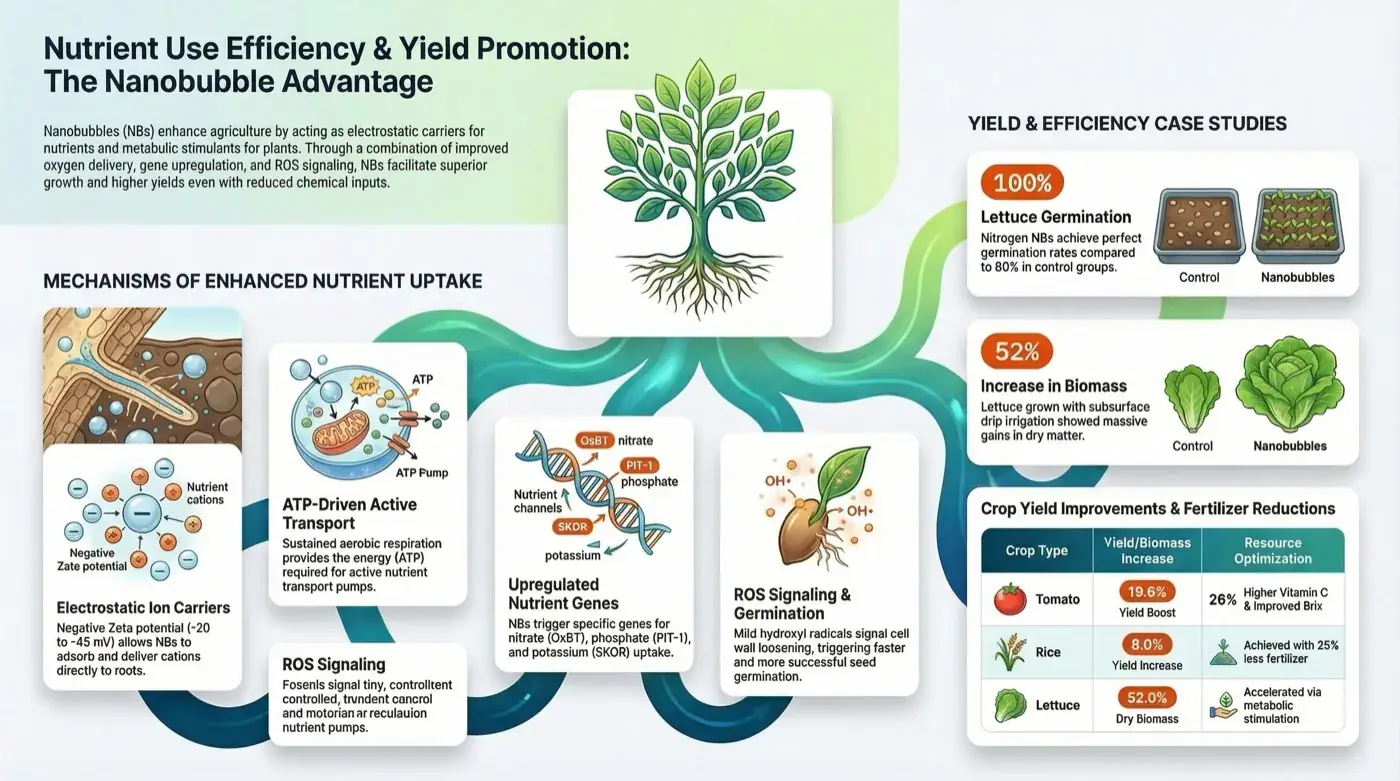
Field experiments with rice found that nanobubble irrigation increased yield by about 8% Wang et al., 2021. The same work reported that nanobubble treatment kept yield equal to the fully fertilized control while fertilizer application was cut by 25%, a result that points to better nutrient use efficiency (NUE).
Tomato: yield and fruit quality
In greenhouse trials, micro-nano bubble water oxygation (MNBWO) increased tomato yield by 16.9% to 19.66% compared with non-aerated controls Liu et al., 2019; Chen et al., 2023. Fruit quality improved as well: vitamin C content rose by 17.7% to 26.5% and soluble sugar content by 20.7% to 39.2%. The ranges span both studies.
Leafy crops: biomass
In subsurface drip trials with treated wastewater, oxygen nanobubble aeration increased lettuce aboveground dry biomass by 52% compared with control subsurface irrigation Baram et al., 2021. In a separate study, air nanobubbles increased aerial fresh weight of Brassica campestris, a leafy brassica, by 34.5% Ebina et al., 2013.
Root growth may contribute. Nanobubble treatment has been observed to increase total root length density in greenhouse tomato, expanding the root system's capacity to take up water and nutrients del Moral Torres et al., 2024.
Nanobubbles may carry nutrient ions to the root surface
One proposed mechanism is electrostatic. Nanobubbles suspended in water typically carry a negative surface charge, measured as , and have a large surface area for their volume. The negatively charged gas–liquid interface attracts positively charged nutrient ions (cations) such as ammonium (NH₄⁺), potassium (K⁺), calcium (Ca²⁺) and magnesium (Mg²⁺), so the bubbles may act as carriers that bring these ions to the root surface and raise their availability Arablousabet & Povilaitis, 2024; Wang et al., 2021.
The gas matters. Ahmed et al. reported a larger negative zeta potential for nitrogen nanobubbles than for air nanobubbles, which they attributed to differences in ionization energy Ahmed et al., 2018. A stronger charge would let nitrogen nanobubbles hold more cations, which may help explain why they often promoted vegetative growth more than other gases in that work.
This carrier role is a proposed mechanism. The lesson cites no measurement of ions actually delivered to roots by bubbles.
Oxygen keeps the roots' nutrient pumps powered
Roots take up nitrogen (N), phosphorus (P) and potassium (K) partly by active transport, which needs energy in the form of adenosine triphosphate (ATP). Oxygen supply largely sets how much ATP the roots can make.
In heavy or waterlogged soils, slows aerobic respiration and pushes roots toward anaerobic metabolism, which yields much less ATP. Keeping dissolved oxygen () high with oxygen nanobubbles is proposed to sustain aerobic respiration through the tricarboxylic acid (TCA) cycle, supplying the ATP that ion pumps and transport proteins need Zheng et al., 2025; Ahmed et al., 2018.
Nutrient-uptake genes were more active in rice
Laboratory studies on rice seedlings found that nanobubble treatment upregulated genes for nutrient absorption, including OsBT (nitrate uptake), PiT-1 (phosphate transport) and SKOR (potassium transport) Wang et al., 2021. This is consistent with a genetic contribution to the higher NUE measured in the same work, although gene expression in seedlings does not by itself show how much more fertilizer a field crop takes up.
Germination depended on the gas
The effect of nanobubbles on germination varied with the gas used. In a comparison on lettuce, carrot and fava bean, nitrogen nanobubbles gave the most consistent promotion Ahmed et al., 2018. Lettuce germination reached 100% with nitrogen nanobubbles, against 85% with oxygen, 82% with air and 80% with tap water.
Air nanobubbles generated with electric fields raised lettuce germination from about 20% in the control to 96% within two days Jannesari et al., 2024. The low germination of the control makes the relative gain large.
Barley seeds submerged in nanobubble water reached 58% germination after 17 hours, twice the 28% measured in distilled water Liu et al., 2015.
Reactive oxygen species act within a window
The proposed explanation for faster germination is an "oxidative window". Liu et al. found that nanobubbles produce low levels of reactive oxygen species (), including hydroxyl radicals (•OH) and superoxide anions (O₂•−) Liu et al., 2015. Within a certain range, these act as signal molecules that loosen cell walls and allow cell elongation, both needed for germination.
Too much ROS inhibits germination. Oxygen nanobubbles produced the most ROS, which exceeded the tolerance of sensitive seeds such as carrot, so they gave no significant promotion there. Nitrogen and air nanobubbles produced moderate ROS levels that stayed within the window that stimulated germination Ahmed et al., 2018; Liu et al., 2016.
What this means in practice
These results come from settings where oxygen or nutrient supply limited growth: saturated or heavy soils, subsurface drip, greenhouse tomato, and germination tests. A site testing nanobubble irrigation for nutrient use should keep the fertilizer program, irrigation schedule and water treatment identical between treated and control zones.
What to measure: DO in mg/L at the emitter; plant tissue or sap nutrient levels through the season; yield per unit of fertilizer applied; and quality measures such as vitamin C or soluble sugars where they matter for the market. For germination, count germinated seeds at fixed times against a tap-water control.
A reduced-fertilizer comparison, like the one in the rice field experiments, needs a full-rate control alongside it and a full season before any change to the fertilizer plan. Oxygen supports the roots' ability to take up nutrients; it does not supply them, and it does not replace the fertilizer program.
Limits and open questions
- The rice fertilizer result comes from one body of work on one crop. It is not a general rule for other crops or soils.
- The electrostatic carrier mechanism and the ATP explanation are proposed; the lesson cites no direct measurement of either at the root surface.
- Gene expression was measured in rice seedlings in the laboratory, not in field crops.
- Germination results are seed tests. They do not predict field yield, and the electric-field result started from a control that germinated at about 20%.
- The best gas depended on the species: oxygen nanobubbles produced enough ROS to exceed carrot seed's tolerance.
- Tomato yield and quality ranges combine two greenhouse studies with their own conditions.
Questions
Can nanobubble irrigation replace part of my fertilizer?
One set of rice field experiments matched the fully fertilized yield with 25% less fertilizer. That is one crop and one body of work, not a general rule. Any cut should be tested against a full-rate control over a full season. Nanobubbles may support uptake; they do not supply nutrients.
Which gas worked best for germination?
In lettuce, nitrogen nanobubbles gave 100% germination against 85% for oxygen, 82% for air and 80% for tap water. Oxygen nanobubbles produced the most reactive oxygen species, which exceeded carrot seed's tolerance. The best gas depended on the species, so test the crop you grow.
How would oxygen help nutrient uptake?
Roots take up nitrogen, phosphorus and potassium partly by active transport, which uses energy (ATP) from aerobic respiration. Short of oxygen, roots shift to anaerobic metabolism and make much less ATP. Oxygenated root zones are proposed to keep those transport systems powered.
References
- Wang, Y., Wang, S., Sun, J., et al. (2021). Nanobubbles promote nutrient utilization and plant growth in rice by upregulating nutrient uptake genes and stimulating growth hormone production. Science of The Total Environment, 800, 149627. https://doi.org/10.1016/j.scitotenv.2021.149627 ↩
- Liu, Y., Zhou, Y., Wang, T., et al. (2019). Micro-nano bubble water oxygation: Synergistically improving irrigation water use efficiency, crop yield and quality. Journal of Cleaner Production, 222, 835-843. https://doi.org/10.1016/j.jclepro.2019.02.208 ↩
- Chen, W., Bastida, F., Liu, Y., et al. (2023). Nanobubble oxygenated increases crop production via soil structure improvement: The perspective of microbially mediated effects. Agricultural Water Management, 282, 108263. https://doi.org/10.1016/j.agwat.2023.108263 ↩
- Baram, S., Evans, J. F., Berezkin, A., et al. (2021). Irrigation with treated wastewater containing nanobubbles to aerate soils and reduce nitrous oxide emissions. Journal of Cleaner Production, 280, 124509. https://doi.org/10.1016/j.jclepro.2020.124509 ↩
- Ahmed, A. K. A., Shi, X., Hua, L., et al. (2018). Influences of Air, Oxygen, Nitrogen, and Carbon Dioxide Nanobubbles on Seed Germination and Plant Growth. Journal of Agricultural and Food Chemistry, 66, 5117-5124. https://doi.org/10.1021/acs.jafc.8b00333 ↩
- Liu, S., Oshita, S., Makino, Y., et al. (2015). Oxidative Capacity of Nanobubbles and Its Effect on Seed Germination. ACS Sustainable Chemistry & Engineering, 4, 1347-1353. https://doi.org/10.1021/acssuschemeng.5b01368 ↩
- Ebina, K., Shi, K., Hirao, M., et al. (2013). Oxygen and Air Nanobubble Water Solution Promote the Growth of Plants, Fishes, and Mice. PLoS ONE, 8, e65339. https://doi.org/10.1371/journal.pone.0065339 ↩
- del Moral Torres, F., Hernández Maqueda, R., Meca Abad, D. E. (2024). Enhancing Root Distribution, Nitrogen, and Water Use Efficiency in Greenhouse Tomato Crops Using Nanobubbles. Horticulturae, 10, 463. https://doi.org/10.3390/horticulturae10050463 ↩
- Arablousabet, Y., Povilaitis, A. (2024). Assessing the Role of Air Nanobubble-Saturated Water in Enhancing Soil Moisture, Nutrient Retention, and Plant Growth. Sustainability, 16, 5727. https://doi.org/10.3390/su16135727 ↩
- Zheng, K., Zeng, H., Liu, R., et al. (2025). Research Progress on the Regulation of Plant Rhizosphere Oxygen Environment by Micro-Nano Bubbles and Their Application Prospects in Alleviating Hypoxic Stress. Agronomy, 15, 2620. https://doi.org/10.3390/agronomy15112620 ↩
- Jannesari, M., Caslin, A., English, N. J. (2024). Electric field-based air nanobubbles (EF-ANBs) irrigation on efficient crop cultivation with reduced fertilizer dependency. Journal of Environmental Management, 362, 121228. https://doi.org/10.1016/j.jenvman.2024.121228 ↩
- Liu, S., Oshita, S., Kawabata, S., et al. (2016). Identification of ROS Produced by Nanobubbles and Their Positive and Negative Effects on Vegetable Seed Germination. Langmuir, 32, 11295-11302. https://doi.org/10.1021/acs.langmuir.6b01621 ↩