Root zone mechanisms
How does oxygen delivered through irrigation reach roots in heavy, waterlogged soils?
On this page
Nanobubble irrigation kept more oxygen in a heavy soil
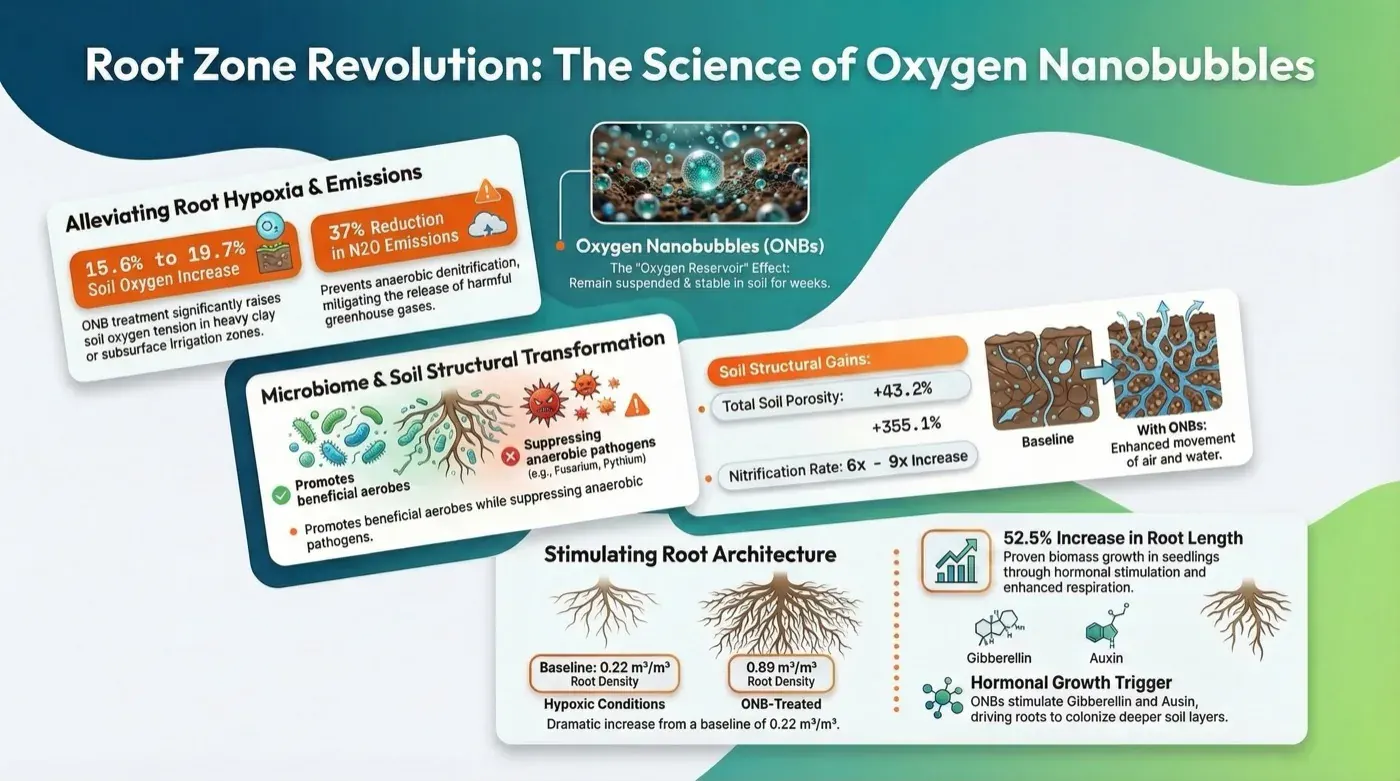
Oxygen nanobubbles () in drip irrigation water raised soil oxygen in a clay soil in a lysimeter study, most of all under surface drip Baram et al., 2021. Soil oxygen rose from 15.6% to 19.7% under surface drip (p < 0.0001) and from 18.2% to 19.2% under subsurface drip. The soil had been degraded by irrigation with treated wastewater.
The problem the study addresses is in the . Each irrigation event sends a saturated wetting front through the soil that pushes air out of the pores, and the oxygen diffusion rate () that roots rely on for respiration falls Baram et al., 2021. Clay soils are the hard case: their small, tortuous pores restrict gas exchange, so the oxygen lost during irrigation returns slowly.
Nanobubbles behave differently from the large bubbles of conventional aeration, which rise and burst. Their buoyancy is negligible, and a review describes them staying suspended in the soil solution for days to weeks and releasing oxygen slowly, like a reservoir Zheng et al., 2025. A follow-up study reported that drip irrigation with nanobubble-oxygenated treated wastewater improved soil aeration, including during irrigation events, when anaerobic pockets would otherwise form Baram et al., 2022.
These are lysimeter results from one soil. The gain under subsurface drip was about one percentage point, much smaller than under surface drip, and the figures hold for the conditions tested: treated wastewater, clay and lysimeter scale.
Nitrous oxide fell as the soil stayed aerobic
In the same lysimeter study, cumulative nitrous oxide (N₂O) emissions were 37% lower under surface drip and 14% lower under subsurface drip with ONBs than in the controls Baram et al., 2021.
The proposed link is microbial. N₂O is produced largely through denitrification, an anaerobic pathway that soil microbes run when oxygen is scarce. By keeping the soil more aerobic, the nanobubble treatment made conditions less favorable to denitrification. The reduction tracked the oxygen gain: it was larger under surface drip, where soil oxygen rose more.
N₂O is a potent greenhouse gas, but these figures belong to one study, one soil and one irrigation regime. They are not an emissions factor for other soils or other irrigation systems.
Soil microbes shifted toward aerobic, nutrient-cycling groups
In a drip-irrigation study, nanobubble treatment shifted the soil bacterial community toward aerobic groups involved in nutrient cycling Zhou et al., 2022. Higher dissolved oxygen () acted as a selection pressure: overall richness (alpha diversity) fell while specific functional groups became more abundant.
Proteobacteria and Nitrospirae increased in relative abundance in nanobubble-treated soil. Nitrospirae convert nitrite to nitrate, a step in nitrification, and their abundance correlated positively with total oxygen concentration Zhou et al., 2022.
Functional predictions with FAPROTAX pointed the same way. Groups for aerobic chemoheterotrophy and nitrification were enriched, while anaerobic functions such as nitrate reduction and fermentation were lower Zhou et al., 2022. FAPROTAX assigns functions from taxonomy, so these are predicted functions, not measured process rates.
Two reviews connect this shift to root health. They describe root pathogens such as Pythium and Fusarium as favored by stagnant, hypoxic root zones, and propose that keeping the root zone aerobic makes conditions less favorable to them Mamun & Islam, 2025; Zheng et al., 2025. This is a proposed mechanism from review articles; the lesson cites no controlled trial of disease incidence.
Roots grew longer and reached deeper
Nanobubble-treated plants changed their root architecture in several studies. In greenhouse tomato, total root length density was 0.89 m³ m⁻³ with nanobubbles against 0.22 m³ m⁻³ in controls del Moral Torres et al., 2024. Roots also colonized deeper soil (15–30 cm) and the zone near the emitters, where localized hypoxia usually keeps them out.
In rice seedlings, high-frequency nanobubble treatment increased root length by 52.5% and raised total root biomass compared with untreated controls Wang et al., 2021. The gain is attributed to greater aerobic respiration and metabolic activity in the roots.
The proposed mechanism is hormonal. Nanobubble treatment was associated with more gibberellin (GA) and indole-3-acetic acid (IAA, an auxin), hormones that drive cell division and elongation in roots, in aquatic plants and in rice Wang et al., 2020; Wang et al., 2021. Auxin also promotes lateral and adventitious roots, which add absorptive surface for water and nutrients Wang et al., 2020; Zheng et al., 2025.
The root measurements come from greenhouse tomato and rice seedlings. How strongly a field crop responds is likely to depend on how short of oxygen its root zone was to begin with.
What this means in practice
These findings apply where roots are short of oxygen: heavy or clay soils, drip or subsurface drip that saturates the root zone, and low-quality irrigation water such as treated wastewater. In a well-drained, well-aerated soil there is less hypoxia to relieve, and less reason to expect the same response.
What to measure: DO in the irrigation water in mg/L at the emitter, not only at the generator; soil oxygen or ODR at root depth before, during and after irrigation; root length density and depth distribution from soil cores; and yield records. Where emissions matter, N₂O needs repeated chamber measurements through a season, not a single sample.
How to test it: run a treated block and an untreated block on the same soil, irrigation schedule and fertilizer program, and compare them over at least one full crop cycle. Keep sanitation, water treatment and crop protection the same in both. Root-zone oxygen supports root health and beneficial microbes; it does not replace those programs.
Limits and open questions
- The soil-oxygen and N₂O figures come from lysimeters with treated wastewater on clay soil, not from open fields or other soil types.
- The N₂O result is from one study. It is not an emissions factor and should not be generalized to other systems.
- Microbial functions were predicted from taxonomy with FAPROTAX, not measured as process rates.
- The link to Pythium and Fusarium comes from review articles; no disease-incidence trial is cited here.
- Root results come from greenhouse tomato, rice seedlings and aquatic plants. The hormone mechanism is proposed, not established for field crops.
- Generator type, bubble size and bubble concentration are not reported here for each study.
Questions
Do oxygen nanobubbles raise soil oxygen in the field?
The clearest figures come from lysimeters, not open fields. Soil oxygen rose from 15.6% to 19.7% under surface drip and from 18.2% to 19.2% under subsurface drip with treated wastewater on clay. Field results depend on soil texture, drainage and irrigation schedule, so measure at your own root depth.
Do nanobubbles control root diseases?
No controlled disease trial is cited here. Reviews link stagnant, hypoxic root zones with Pythium and Fusarium and propose that better aeration makes conditions less favorable to them. Oxygen supports root health and aerobic microbes; it does not replace sanitation, clean water or crop protection.
Why would nanobubbles lower nitrous oxide?
Nitrous oxide comes largely from denitrification, which soil microbes run when oxygen is scarce. In one lysimeter study, oxygen nanobubble irrigation lowered cumulative N₂O by 37% under surface drip and 14% under subsurface drip. That is one soil and one set of conditions, not a general emissions figure.
References
- Baram, S., Evans, J. F., Berezkin, A., et al. (2021). Irrigation with treated wastewater containing nanobubbles to aerate soils and reduce nitrous oxide emissions. Journal of Cleaner Production, 280, 124509. https://doi.org/10.1016/j.jclepro.2020.124509 ↩
- del Moral Torres, F., Hernández Maqueda, R., Meca Abad, D. E. (2024). Enhancing Root Distribution, Nitrogen, and Water Use Efficiency in Greenhouse Tomato Crops Using Nanobubbles. Horticulturae, 10, 463. https://doi.org/10.3390/horticulturae10050463 ↩
- Wang, Y., Wang, S., Sun, J., et al. (2021). Nanobubbles promote nutrient utilization and plant growth in rice by upregulating nutrient uptake genes and stimulating growth hormone production. Science of The Total Environment, 800, 149627. https://doi.org/10.1016/j.scitotenv.2021.149627 ↩
- Zhou, Y., Bastida, F., Liu, Y., et al. (2022). Impacts and mechanisms of nanobubbles level in drip irrigation system on soil fertility, water use efficiency and crop production: The perspective of soil microbial community. Journal of Cleaner Production, 333, 130050. https://doi.org/10.1016/j.jclepro.2021.130050 ↩
- Zheng, K., Zeng, H., Liu, R., et al. (2025). Research Progress on the Regulation of Plant Rhizosphere Oxygen Environment by Micro-Nano Bubbles and Their Application Prospects in Alleviating Hypoxic Stress. Agronomy, 15, 2620. https://doi.org/10.3390/agronomy15112620 ↩
- Baram, S., Weinstein, M., Evans, J. F., et al. (2022). Drip irrigation with nanobubble oxygenated treated wastewater improves soil aeration. Scientia Horticulturae, 291, 110550. https://doi.org/10.1016/j.scienta.2021.110550 ↩
- Mamun, M. A., Islam, T. (2025). Oxygenated Nanobubbles as a Sustainable Strategy to Strengthen Plant Health in Controlled Environment Agriculture. Sustainability, 17, 5275. https://doi.org/10.3390/su17125275 ↩
- Wang, S., Liu, Y., Lyu, T., et al. (2020). Aquatic Macrophytes in Morphological and Physiological Responses to the Nanobubble Technology Application for Water Restoration. ACS ES&T Water, 1, 376-387. https://doi.org/10.1021/acsestwater.0c00145 ↩