Post-harvest washing and quality
What has research measured when ozone and other gas nanobubbles are used to wash fresh produce?
On this page
Ozone micro-nanobubbles lowered pesticide residues more than plain water
Washing with ozone micro-nanobubbles (OMNBs) or ozonated water removed more pesticide residue from fruit and vegetables than conventional washing, in the studies reviewed by Pal & Kioka, 2025. The target is hydrophobic residues, such as organophosphates, that cling to produce surfaces.
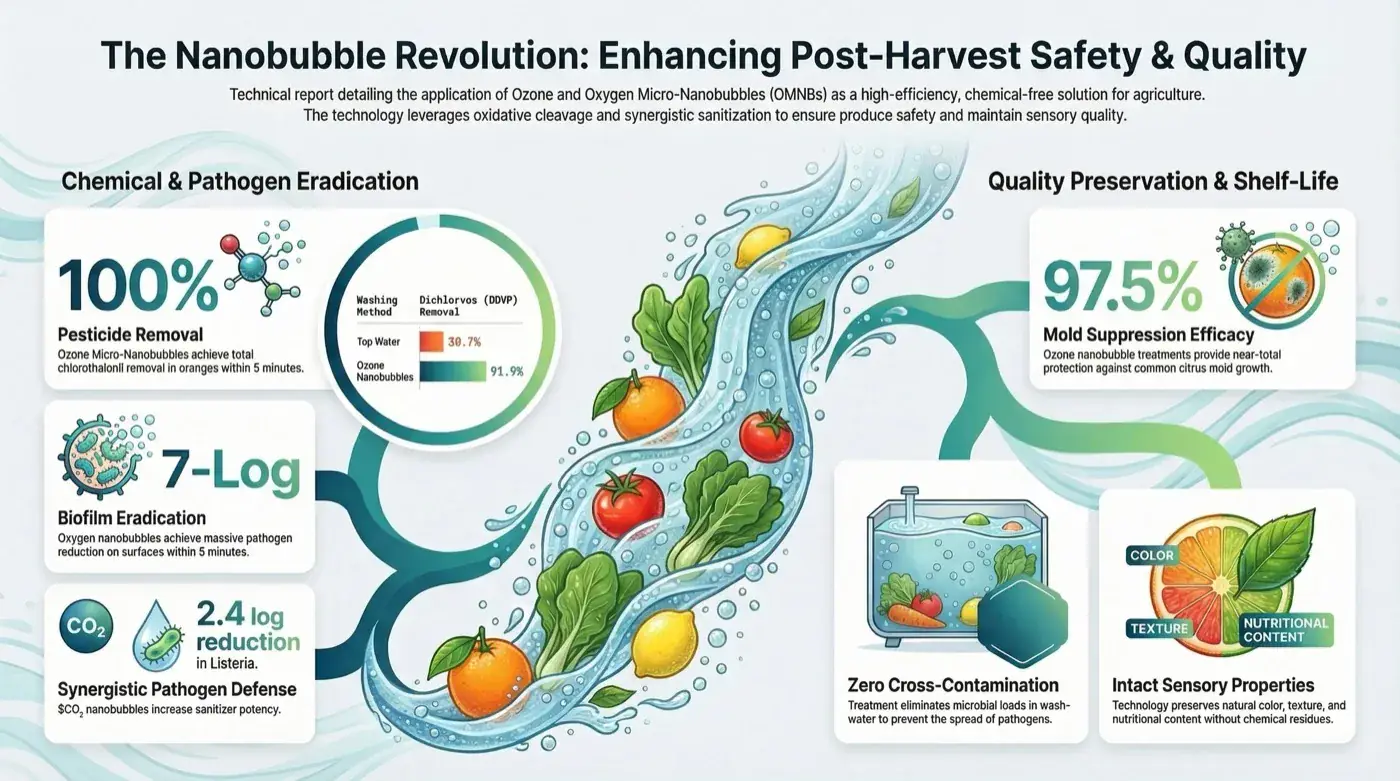
- Dichlorvos (DDVP): on tomatoes, ozonated water removed 91.9% of DDVP, against 30.7% for tap-water washing.
- Chlorothalonil: a 5-minute ozonation with micro-nanobubbles was reported to remove 100% of chlorothalonil residues from oranges.
- Fenitrothion: OMNBs generated by decompression removed more fenitrothion from lettuce, cherry tomatoes and strawberries than macrobubbles did. The review attributes this to nanobubbles reaching micropores and waxy cuticles.
- Apples: OMNB washing removed 98–100% of pesticide residues, more than tap water, without altering the fruit's sensory properties.
Two mechanisms are proposed Pal & Kioka, 2025. The first is : macrobubbles burst at the surface, while nanobubbles stay in the water, keeping dissolved ozone high (supersaturated) and extending its contact time with residues. The second is oxidation: collapsing OMNBs generate hydroxyl radicals (•OH), which are non-selective and highly reactive. They attack functional groups of pesticide molecules, such as amino, methoxy, dichlorovinyl and nitro groups, through oxidative cleavage, hydrolysis and photolysis, breaking them down toward water, carbon dioxide and inorganic salts.
These figures reach this lesson through one review, and some, such as the DDVP result, are for ozonated water in general rather than nanobubbles specifically. The lesson does not report whether intermediate breakdown products were measured.
Nanobubbles reduced biofilms, most when combined with wash chemistry
On food-contact surfaces, nanobubbles reduced bacterial biofilms on their own, and combining them with wash chemistry gave the largest reductions Shiroodi et al., 2021. Oxygen nanobubbles reduced Vibrio parahaemolyticus biofilms on stainless steel and plastic by 7 log within 5 minutes. Listeria innocua and E. coli biofilms were more resistant, with reductions of 1 to 3 log CFU/cm². When nanobubbles were combined with neutral electrolyzed water (NEW), the study reported complete removal of the biofilms.
The pairing of bubbles with wash chemistry has been studied with chlorine as well: Sekhon et al. examined how gas ultrafine bubbles affect the potency of chlorine solutions against Listeria monocytogenes biofilms Sekhon et al., 2021. The evidence points to nanobubbles working alongside wash chemistry, not in place of it.
These results were measured on stainless steel and plastic test surfaces. No study cited here measured pathogen reductions on produce itself.
How the reductions are thought to happen
Two effects are proposed, one physical and one chemical, both from biofilm work Shiroodi et al., 2021.
Physically, nanobubbles lower the surface tension of water and the contact angle on surfaces, which increases wetting and lets the wash solution penetrate the biofilm matrix. On stainless steel, the contact angle fell from 70.1° to 67.3°. The bubbles are also thought to scour the surface and detach extracellular polymeric substances (EPS), the matrix that holds a biofilm together.
Chemically, Raman spectroscopy showed weaker bands for proteins, carbohydrates and DNA in the biofilm matrix after nanobubble treatment. This is interpreted as reactive oxygen species (), especially hydroxyl radicals formed as bubbles collapse, degrading the EPS and oxidizing cell membrane components Shiroodi et al., 2021.
The contact-angle change was small, and the role of ROS is inferred from the spectra rather than measured directly.
Mold and produce quality
Ozone treatments in water enhanced by nanobubbles reduced mold growth on citrus by up to 97.5% in studies reviewed by Pal & Kioka, 2025. A lower microbial load at washing is one of the main factors in how long produce keeps, but the lesson cites no storage trial that measured shelf life in days.
Quality held in the reviewed studies. Ozonated water kept the green color of peppers, measured as hue angle (h), without harming texture or visual appearance, and OMNB washing of apples left their sensory properties unchanged compared with tap water Pal & Kioka, 2025.
What this means in practice
These findings apply to produce wash lines, flumes and dump tanks where pesticide residues, biofilm on equipment surfaces or microbial load are the concern. The studies tested nanobubbles alongside wash chemistry, not in place of it.
What to measure: pesticide residues by accredited laboratory analysis before and after washing, against the current wash; microbial counts in log CFU per unit or per cm² on product and on equipment surfaces, with untreated controls; dissolved ozone and oxidation-reduction potential () in the wash water if ozone is used, together with water temperature and organic load; and quality through storage, such as color, texture and decay.
How to test it: run a side-by-side trial against the current wash with the same contact time and product load, repeated across batches. Any change to an antimicrobial wash in a food facility has to go through the site's food-safety plan and the applicable regulations, and ozone near workers needs air monitoring. Nanobubbles do not replace a validated sanitation program.
Limits and open questions
- Most pesticide, mold and quality figures come from one review; the original trials are not individually cited here.
- Several results, such as DDVP removal and pepper color, are for ozonated water in general; the share due to nanobubbles is not separated.
- No study cited here measured pathogen reductions on produce; the microbial results are for biofilms on test surfaces, with specific strains and contact times.
- No study cited here measured pesticide breakdown products or shelf life in days.
- The figures describe test conditions. In a working wash line, organic load, water temperature and contact time change, and results may differ.
Questions
Do ozone nanobubbles remove pesticide residues from produce?
In studies reviewed by Pal & Kioka (2025), ozonated water removed 91.9% of dichlorvos from tomatoes, against 30.7% for tap water, and a 5-minute micro-nanobubble ozonation removed 100% of chlorothalonil from oranges. Results depend on the pesticide, the produce and contact time.
Can nanobubbles replace chlorine or other wash chemistry?
The evidence points the other way. Nanobubbles reduced biofilms on their own, but combined with neutral electrolyzed water they gave the largest reductions, and their pairing with chlorine solutions has also been studied. They were studied as an addition to wash chemistry, not a substitute for a validated food-safety program.
Does nanobubble washing extend shelf life?
It has not been measured directly here. A review reported up to 97.5% less mold growth on citrus with ozone treatments enhanced by nanobubbles, and no loss of color in peppers or of sensory quality in apples. No storage trial in days is cited, so test it with your own product.
References
- Pal, P., Kioka, A. (2025). Micro and nanobubbles enhanced ozonation technology: A synergistic approach for pesticides removal. Comprehensive Reviews in Food Science and Food Safety, 24, e70133. https://doi.org/10.1111/1541-4337.70133 ↩
- Shiroodi, S., Schwarz, M. H., Nitin, N., et al. (2021). Efficacy of Nanobubbles Alone or in Combination with Neutral Electrolyzed Water in Removing Escherichia coli O157:H7, Vibrio parahaemolyticus, and Listeria innocua Biofilms. Food and Bioprocess Technology, 14, 287-297. https://doi.org/10.1007/s11947-020-02572-0 ↩
- Sekhon, A. S., Unger, P., Singh, A., et al. (2021). Impact of gas ultrafine bubbles on the potency of chlorine solutions against Listeria monocytogenes biofilms. Journal of Food Safety, 42, e12954. https://doi.org/10.1111/jfs.12954 ↩