Combining gases and cavitation
What happens when cavitation meets reactive gases, and how do gases and cavitation methods compare?
On this page
What combining cavitation and gases does
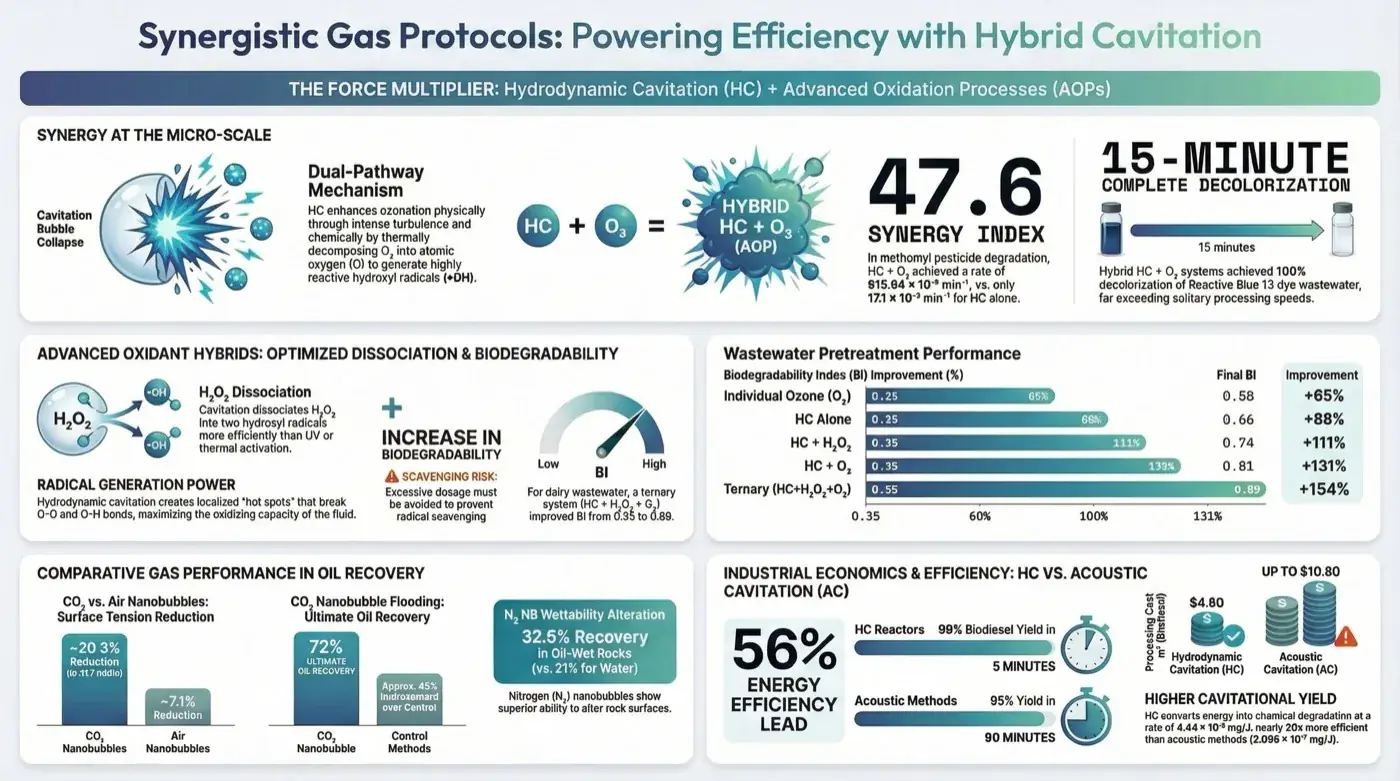
Pairing (hydrodynamic cavitation) with a reactive gas such as ozone, or with a liquid oxidant such as hydrogen peroxide (H₂O₂), creates a hybrid (advanced oxidation process). In the studies below, these hybrids degraded pollutants faster than either step on its own. The mechanism is that collapsing cavitation bubbles act as micro-reactors, breaking oxidants down into non-selective radicals.
Cavitation plus ozone
Cavitation improves ozonation in two ways Wang et al., 2022:
- Physical: intense turbulence and micro-circulation reduce resistance and break ozone gas into micro-nanobubbles that dissolve rapidly.
- Chemical: the extreme conditions of cavity collapse (hot spots) thermally decompose ozone (O₃) into atomic oxygen (O) and oxygen molecules (O₂). The atomic oxygen reacts with water to form hydroxyl radicals (•OH), which are far more reactive than molecular ozone.
The benefit is expressed as a synergy index. In the degradation of the pesticide methomyl, the combined process reached a rate of 915.94 × 10⁻³ min⁻¹, against 2.1 × 10⁻³ min⁻¹ for ozonation and 17.1 × 10⁻³ min⁻¹ for cavitation alone, a synergy coefficient of up to 47.6 Mohod et al., 2023; Wang et al., 2022.
The same pattern appeared in dye wastewater. With Reactive Blue 13, the hybrid system decolorized the water within 15 minutes and reduced total organic carbon (TOC) by 72% in 120 minutes, faster than either process alone Wang et al., 2022.
Cavitation plus hydrogen peroxide
Cavitation splits H₂O₂ into two hydroxyl radicals more efficiently than heat or UV activation alone. The dose has an optimum: excess H₂O₂ scavenges the radicals it produces and forms weaker hydroperoxyl radicals (HO₂•), which lowers efficiency Mohod et al., 2023.
Side-by-side gas comparisons in oil recovery
Direct comparisons of nanobubble gases show that the choice of gas changes fluid behavior:
- CO₂ versus air: CO₂ nanobubbles reduced the surface tension of a surfactant-polymer solution by about 20.3%, to 31.7 mN/m, while air nanobubbles reduced it by about 7.1%, to 59.7 mN/m English, 2025.
- CO₂ in water flooding: in core-flood tests, water flooding enhanced with CO₂ nanobubbles reached an ultimate recovery of 71–72%, about 45% above the control, which the review attributed to oil swelling and viscosity reduction English, 2025.
- Nitrogen versus water: in spontaneous imbibition tests on oil-wet carbonate rock, nitrogen nanobubble solutions reached 32.6% ultimate recovery, against 21% for distilled water, pointing to wettability change or slippage Elnaggar et al., 2025.
Energy and cost: hydrodynamic versus acoustic cavitation
Energy cost is a main barrier to industrial use, and the reviews cited here favor HC over acoustic cavitation (AC) for bulk processing:
- Biodiesel: HC reactors with multi-hole orifice plates reached 99% biodiesel yield in 5 minutes; ultrasonic bath methods needed 90 minutes to reach 95%. Processing cost was estimated at 4.80 USD/m³ for HC, against 6.7–10.8 USD/m³ for acoustic methods Cako et al., 2022.
- Pollutant degradation: for methyl parathion, the cavitational yield of HC was 4.44 × 10⁻⁶ mg/J, against 2.098 × 10⁻⁷ mg/J for AC Mohod et al., 2023.
- Fuel desulfurization: vortex-diode HC systems reported costs as low as 36 USD/m³ at 100% reported efficiency. Comparable acoustic methods were estimated to cost more, because converting electrical energy into sound is inefficient Cako et al., 2022.
Aeration economics
A net present value (NPV) analysis compared conventional blowers with electric-field nanobubble generation for wastewater aeration. It suggested that nanobubble aeration costs scaled roughly linearly with treatment level, avoiding the exponential cost curve it attributed to conventional aeration at high cleanliness requirements English, 2022.
Limits and open questions
- Most figures come from review articles that compile studies run under different conditions; they are not results from one controlled comparison.
- The synergy and degradation results are for specific pollutants (methomyl, Reactive Blue 13, methyl parathion) and may not transfer to other compounds or water matrices.
- The CO₂ and air surface-tension results imply different starting values, so they may not share a baseline; check the source before comparing them.
- The oil-recovery results come from laboratory core-flood and imbibition tests on different rocks, so they cannot be ranked against each other.
- Cost figures are estimates from reviews, not quotes for a plant, and the NPV result is a model, not measured plant data.
Questions
How does cavitation make ozone work better?
Cavitation breaks ozone gas into micro-nanobubbles that dissolve quickly, and collapsing cavities decompose ozone into atomic oxygen, which forms hydroxyl radicals. In methomyl degradation, the combined rate was 915.94 × 10⁻³ min⁻¹, against 17.1 × 10⁻³ min⁻¹ for cavitation alone, a synergy coefficient of up to 47.6.
Is hydrodynamic cavitation cheaper than acoustic cavitation?
In the reviews cited here, it was for the processes compared. Hydrodynamic cavitation produced biodiesel at an estimated 4.80 USD/m³, against 6.7–10.8 USD/m³ for acoustic methods, and its cavitational yield for methyl parathion was higher. Costs at a real plant depend on scale, energy prices and the process.
Which gas gave the most oil recovery?
Among the results cited here, water flooding enhanced with CO₂ nanobubbles reached 71–72% ultimate recovery in core-flood tests, while nitrogen nanobubble solutions reached 32.6%, against 21% for distilled water, in oil-wet carbonate rock. The tests used different rocks and methods, so the numbers cannot be ranked directly.
References
- Mohod, A. V., Teixeira, A. C. S. C., Bagal, M. V., et al. (2023). Degradation of organic pollutants from wastewater using hydrodynamic cavitation: A review. Journal of Environmental Chemical Engineering, 11, 109773. https://doi.org/10.1016/j.jece.2023.109773 ↩
- Wang, B., Liu, Y., Zhang, H., et al. (2022). Hydrodynamic cavitation and its application in water treatment combined with ozonation: A review. Journal of Industrial and Engineering Chemistry, 114, 33-51. https://doi.org/10.1016/j.jiec.2022.07.031 ↩
- Cako, E., Wang, Z., Castro-Muñoz, R., et al. (2022). Cavitation based cleaner technologies for biodiesel production and processing of hydrocarbon streams: A perspective on key fundamentals, missing process data and economic feasibility – A review. Ultrasonics Sonochemistry, 88, 106081. https://doi.org/10.1016/j.ultsonch.2022.106081 ↩
- English, N. J. (2025). Environmentally Sustainable and Energy-Efficient Nanobubble Engineering: Applications in the Oil and Fuels Sector. Fuels, 6, 50. https://doi.org/10.3390/fuels6030050 ↩
- Elnaggar, H., Taman, A., Ali, R., et al. (2025). Oil Recovery Enhancement by N 2 Nanobubbles. Energy & Fuels, 39, 2482-2499. https://doi.org/10.1021/acs.energyfuels.4c05180 ↩
- English, N. J. (2022). Environmental Exploration of Ultra-Dense Nanobubbles: Rethinking Sustainability. Environments, 9, 33. https://doi.org/10.3390/environments9030033 ↩