Ozone nanobubbles (O₃)
How do ozone nanobubbles oxidize, and what have studies measured?
On this page
What ozone nanobubbles do
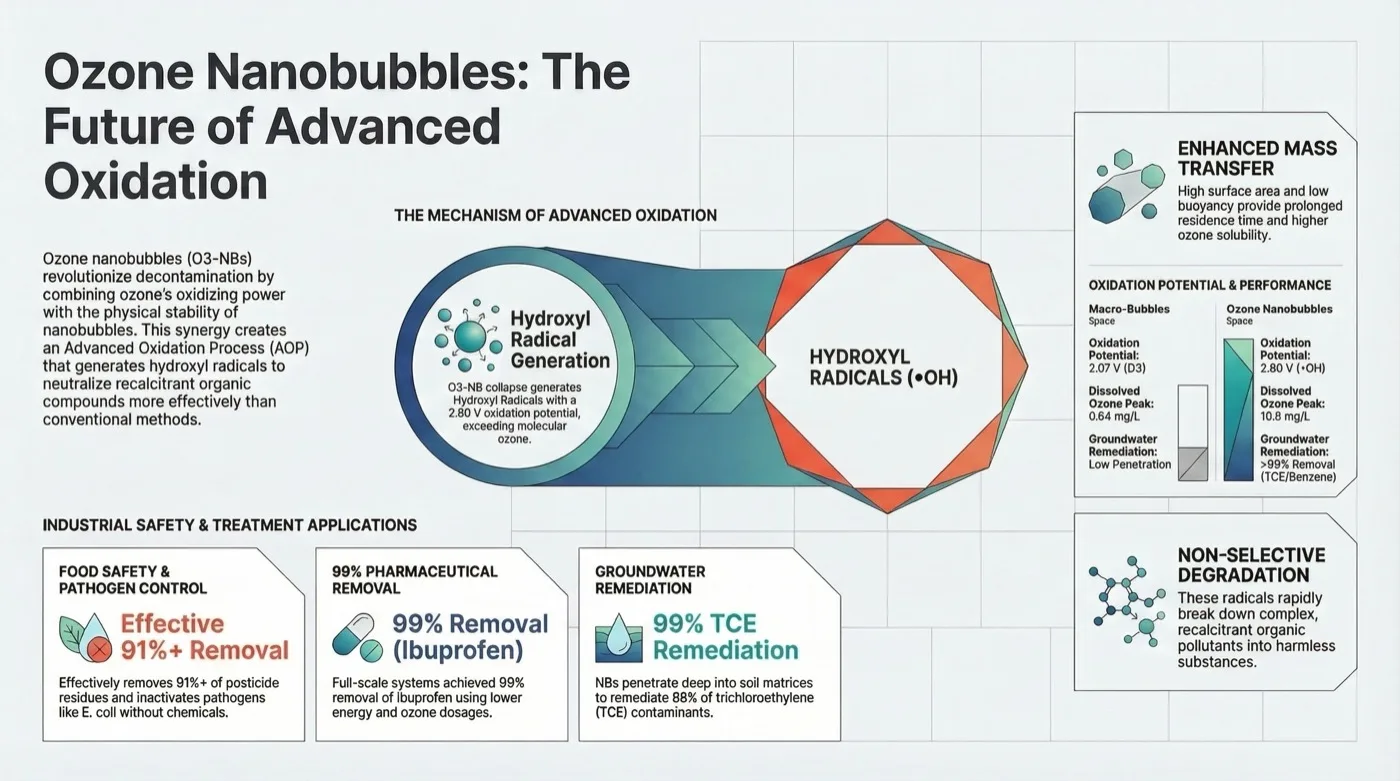
Ozone nanobubbles are an oxidizing treatment. They combine ozone, a strong oxidant, with the physical stability of nanobubbles, which makes them an (advanced oxidation process). The chemistry does the work: ozone and the radicals it forms oxidize pollutants and microbial cells. The physics improves delivery: the nanobubble carries more ozone into the water and keeps it there longer.
Mechanism: hydroxyl radicals
When O₃-NBs collapse, whether triggered by an outside stimulus or by self-decomposition, they generate (reactive oxygen species), mainly the hydroxyl radical (•OH). The hydroxyl radical has a higher oxidation potential than molecular ozone, 2.80 V against 2.07 V, and it reacts non-selectively. That is why it can break down recalcitrant organic compounds Takahashi et al., 2007; Hu & Xia, 2018.
Mass transfer: why the bubble size matters
Large bubbles rise and burst quickly, so much of their ozone leaves the water. O₃-NBs have a high specific surface area and low buoyancy, which lengthens their residence time and raises the of ozone into the liquid Fan et al., 2020; Khuntia et al., 2012.
Produce and fish water: measured reductions
- Pesticide residues: ozone microbubbles lowered residues of the pesticide fenitrothion on vegetables more than conventional washing did Ikeura et al., 2011.
- Fish pathogens: in freshwater, ozone nanobubble treatment reduced the pathogenic fish bacteria tested, and the authors reported it safe for Nile tilapia (Oreochromis niloticus) Jhunkeaw et al., 2021. The proposed mechanism is oxidative stress that damages microbial cell membranes.
Water treatment: recalcitrant pollutants
- Pharmaceuticals: at a full-scale wastewater treatment plant, an O₃-MNB system used as tertiary treatment removed 99% of ibuprofen, with lower ozone doses and energy costs than conventional ozonation Ponce-Robles et al., 2023.
- Dyes and organics: ozone micro-nanobubbles degraded organic contaminants in wastewater, including the azo dye methyl orange. The authors attributed the faster removal to higher ozone solubility combined with radical generation Xia & Hu, 2018.
- Groundwater: in groundwater-remediation studies, removal of trichloroethylene (TCE) and benzene exceeded 99%, which the authors linked to the ability of nanobubbles to penetrate soil matrices Hu & Xia, 2018; Cao & Hu, 2023.
How ozone compares with other gases
Ozone is chosen when the goal is oxidation. Oxygen nanobubbles are chosen to raise dissolved oxygen for respiration, although they can also assist oxidation: one study used oxygen nanobubbles, not ozone, to enhance the visible-light photodegradation of the antibiotic oxytetracycline Wang et al., 2020. Against conventional ozonation, the full-scale ibuprofen result above used less ozone and energy. Pairing ozone with hydrodynamic cavitation is covered in Combining gases and cavitation.
Limits and open questions
- The fish-pathogen result comes from one freshwater study; this profile gives no reduction values, and the result may not transfer to other organisms, waters or foods.
- The pesticide result covers one pesticide and used microbubbles, not nanobubbles.
- The removal figures were measured under each study's dose, water matrix and contact time; they are not predictions for another site.
- This profile does not cover ozone dose, residual ozone or off-gas safety, which any use of ozone has to address.
- These are research findings. They are not a claim about what any equipment does, and ozone treatment does not replace food-safety or biosecurity programs.
Questions
Is ozone nanobubble treatment a chemical treatment?
Yes. Ozone is a reactive oxidant, and the hydroxyl radicals it forms break down pollutants. The nanobubble is the physical part: it keeps ozone in the water longer and transfers it more efficiently than large bubbles do. Physics improves the delivery; chemistry does the oxidation.
Why do hydroxyl radicals matter?
Hydroxyl radicals have an oxidation potential of 2.80 V, compared with 2.07 V for molecular ozone, and they react non-selectively. The studies cited here link the collapse of ozone nanobubbles to hydroxyl radical formation, which helps explain the degradation of recalcitrant organic compounds they report.
What has ozone micro-nanobubble treatment achieved in wastewater?
At full scale, an ozone micro-nanobubble system used as tertiary treatment removed 99% of ibuprofen from treatment-plant effluent, with lower ozone doses and energy costs than conventional ozonation. In groundwater studies, removal of trichloroethylene and benzene exceeded 99%. Results depend on the water matrix and dose.
References
- Takahashi, M., Chiba, K., Li, P. (2007). Free-Radical Generation from Collapsing Microbubbles in the Absence of a Dynamic Stimulus. The Journal of Physical Chemistry B, 111, 1343-1347. https://doi.org/10.1021/jp0669254 ↩
- Hu, L., Xia, Z. (2018). Application of ozone micro-nano-bubbles to groundwater remediation. Journal of Hazardous Materials, 342, 446-453. https://doi.org/10.1016/j.jhazmat.2017.08.030 ↩
- Ponce-Robles, L., Pagán-Muñoz, A., Lara-Guillén, A. J., et al. (2023). Full-Scale O3/Micro-Nano Bubbles System Based Advanced Oxidation as Alternative Tertiary Treatment in WWTP Effluents. Catalysts, 13, 188. https://doi.org/10.3390/catal13010188 ↩
- Cao & Hu, 2023. https://doi.org/10.53243/ICEG2023-57 (DOI registered with mEDRA; no bibliographic record in Crossref) ↩
- Jhunkeaw, C., Khongcharoen, N., Rungrueng, N., et al. (2021). Ozone nanobubble treatment in freshwater effectively reduced pathogenic fish bacteria and is safe for Nile tilapia (Oreochromis niloticus). Aquaculture, 534, 736286. https://doi.org/10.1016/j.aquaculture.2020.736286 ↩
- Fan, W., An, W. g., Huo, M. x., et al. (2020). Solubilization and stabilization for prolonged reactivity of ozone using micro-nano bubbles and ozone-saturated solvent: A promising enhancement for ozonation. Separation and Purification Technology, 238, 116484. https://doi.org/10.1016/j.seppur.2019.116484 ↩
- Khuntia, S., Majumder, S. K., Ghosh, P. (2012). Microbubble-aided water and wastewater purification: a review. Reviews in Chemical Engineering, 28. https://doi.org/10.1515/revce-2012-0007 ↩
- Ikeura, H., Kobayashi, F., Tamaki, M. (2011). Removal of residual pesticide, fenitrothion, in vegetables by using ozone microbubbles generated by different methods. Journal of Food Engineering, 103, 345-349. https://doi.org/10.1016/j.jfoodeng.2010.11.002 ↩
- Xia, Z., Hu, L. (2018). Treatment of Organics Contaminated Wastewater by Ozone Micro-Nano-Bubbles. Water, 11, 55. https://doi.org/10.3390/w11010055 ↩
- Wang, L., Ali, J., Wang, Z., et al. (2020). Oxygen nanobubbles enhanced photodegradation of oxytetracycline under visible light: Synergistic effect and mechanism. Chemical Engineering Journal, 388, 124227. https://doi.org/10.1016/j.cej.2020.124227 ↩