Generation mechanisms and stability
How are nanobubbles produced, and why do they persist in water long after larger bubbles have risen and burst?
On this page
How nanobubbles are generated
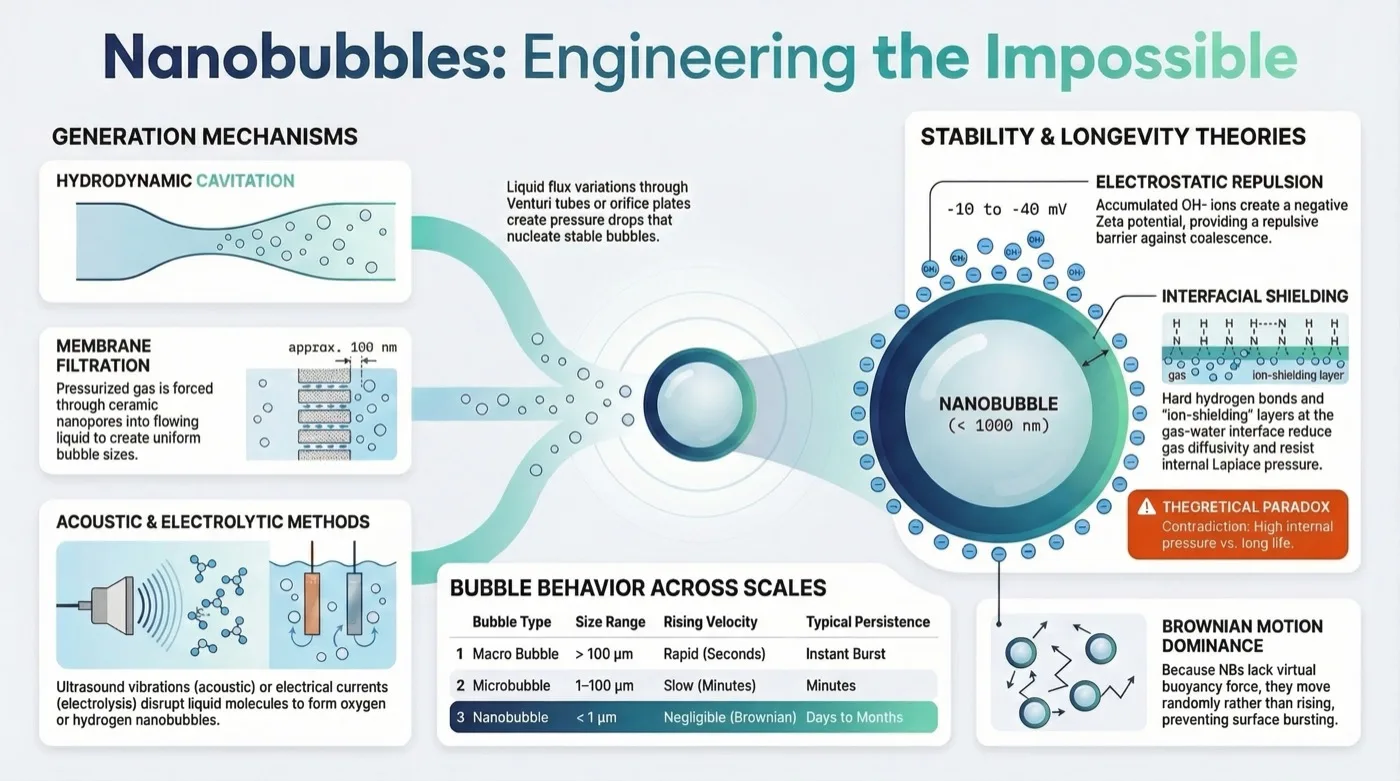
Bulk nanobubbles are made mainly in two ways: by cavitation, where a local pressure drop forms bubbles inside the liquid, and by forcing gas through a porous membrane into a flowing liquid Wang & Wang, 2023. The two routes differ in what controls the bubble size, so they are described separately below.
Hydrodynamic cavitation
(HC) works on the Bernoulli principle. As liquid passes through a constriction its velocity rises and its static pressure falls; where the local pressure drops below the saturated vapor pressure of the liquid, cavities (bubbles) form Ahmed et al., 2018; Akshit et al., 2024. Reviews describe HC as widely adopted and suited to scale-up.
A Venturi tube is a common HC device. Liquid accelerates through a conical convergent section, and the negative-pressure zone that forms draws in gas. The gas–liquid mixture then meets intense hydraulic shear, which breaks the gas into micro- and nanobubbles Li et al., 2021.
Swirling-flow generators rotate the liquid fast enough to open a vortex with a low-pressure core, where nanobubbles nucleate Alam et al., 2022. During generation the liquid often turns milky with microbubbles. Those rise and burst, leaving a transparent suspension of the nanobubbles that remain Foudas et al., 2023.
Ceramic membranes
Membrane generators force pressurized gas through a porous ceramic membrane, for example one with 100 nm pores, into a flowing liquid. The gas pressure must exceed the capillary pressure of the pores (the bubble point), and shear from the flowing liquid detaches the bubbles from the membrane surface Wang & Wang, 2023.
In this route the membrane and the operating pressure set the bubble size. Pore size, the hydrophobicity of the membrane surface and the gas injection pressure all influenced nanobubble size, and higher injection pressures yielded smaller bubbles Ahmed et al., 2018; Phan et al., 2021.
Why nanobubbles persist
Bulk nanobubbles last far longer than classical theory allows, and three physical models have been proposed to explain why. By the Young–Laplace equation, the smaller a bubble, the higher its internal pressure, so a nanobubble should lose its gas and dissolve within microseconds. Laboratory suspensions have instead been reported to persist for months Nirmalkar et al., 2018; Foudas et al., 2023.
Surface charge and ion shielding
The surface-charge model holds that electric charge at the interface counteracts the internal pressure. Nanobubbles in pure water carry a negatively charged interface, attributed to adsorbed hydroxide ions (OH⁻). The charge attracts positive counterions and forms an electric double layer (EDL), and electrostatic repulsion between ions on the bubble surface acts as an outward pressure against the inward surface tension (the Laplace pressure) Nirmalkar et al., 2018.
The size of this charge is measured as , covered in Key physico-chemical properties.
An interfacial "skin"
The skin model holds that material adsorbed at the gas–liquid interface slows the escape of gas. Organic contaminants, surfactants or solid particles collect at the interface and form a rigid or semi-rigid shell. The shell reduces surface tension and acts as a physical barrier to gas diffusion, which inhibits dissolution Yasui et al., 2019; Jin et al., 2022.
Supersaturation and dynamic equilibrium
The third model holds that gas flowing into and out of the bubble reaches a balance. Local gas supersaturation in the liquid around the bubble, or hydrophobic surface interactions that trap gas, would then prevent a net loss of gas from the bubble Akshit et al., 2024; Lasek et al., 2023.
The cited sources present these as alternative explanations. They also depend on different conditions: the skin model needs contaminants, surfactants or particles at the interface, while the surface-charge model is described for pure water.
What this means in practice
In practice, the generation method shapes the bubble population, and on the models above the water itself helps determine how long it lasts. In the membrane work above, pore size, membrane surface and gas pressure changed bubble size, so two generators, or one generator at two settings, should be compared by measured size and concentration in the same water, not by their specifications.
Milky water is not a nanobubble reading: it shows microbubbles, which rise and clear. The nanobubble suspension that remains is transparent and has to be characterized with instruments and controls, as described in Characterization and measurement.
Because the stability models point to charge, dissolved ions, organics and surfactants, a site test should record the water itself (pH, conductivity, temperature) and sample both at the generator outlet and at the point of use, repeating the measurement over time after generation.
Limits and open questions
Most of the evidence in this lesson comes from review articles that summarize laboratory work; the lesson reports no field measurement of generation or stability.
The persistence of months was reported for laboratory suspensions in pure water. How long nanobubbles last in water that carries particles, organic matter, dissolved salts and flow was not measured in the cited work.
The three stability models are presented side by side. The lesson cites no study that tests one against the others under the same conditions, and the size results for membranes come from specific devices that may not transfer to others.
Questions
How are nanobubbles made?
Most are made by hydrodynamic cavitation, where liquid speeds up through a constriction such as a Venturi tube until its pressure drops enough for bubbles to form, or by forcing pressurized gas through a porous ceramic membrane into flowing liquid. In the membrane studies, pore size, membrane surface and gas pressure all changed bubble size.
Why don't nanobubbles dissolve right away?
The Young–Laplace equation predicts that a bubble this small should dissolve within microseconds, yet laboratory samples in pure water have been reported to last for months. The proposed explanations are a negative surface charge that pushes back against internal pressure, an adsorbed skin that slows gas loss, and local supersaturation that balances gas exchange.
Why does freshly treated water turn milky and then clear?
The milkiness comes from microbubbles, which scatter light and then rise and burst. What remains is a transparent suspension of nanobubbles, which are too small to cloud the water. Clear water therefore does not show that treatment failed, and milky water is not evidence of nanobubbles; instruments with proper controls are needed.
References
- Akshit, F., Mao, T., Mohan, M. S. (2024). Future perspective of nanobubble technology in dairy processing applications. Trends in Food Science & Technology, 147, 104420. https://doi.org/10.1016/j.tifs.2024.104420 ↩
- Ahmed, A. K. A., Sun, C., Hua, L., et al. (2018). Generation of nanobubbles by ceramic membrane filters: The dependence of bubble size and zeta potential on surface coating, pore size and injected gas pressure. Chemosphere, 203, 327-335. https://doi.org/10.1016/j.chemosphere.2018.03.157 ↩
- Nirmalkar, N., Pacek, A. W., Barigou, M. (2018). On the Existence and Stability of Bulk Nanobubbles. Langmuir, 34, 10964-10973. https://doi.org/10.1021/acs.langmuir.8b01163 ↩
- Yasui, K., Tuziuti, T., Izu, N., et al. (2019). Is surface tension reduced by nanobubbles (ultrafine bubbles) generated by cavitation?. Ultrasonics Sonochemistry, 52, 13-18. https://doi.org/10.1016/j.ultsonch.2018.11.020 ↩
- Lasek, L., Krzywanski, J., Skrobek, D., et al. (2023). Review of Micro- and Nanobubble Technologies: Advancements in Theory and Applications and Perspectives on Adsorption Cooling and Desalination Systems. Energies, 16, 8078. https://doi.org/10.3390/en16248078 ↩
- Wang, Y., Wang, T. (2023). Preparation Method and Application of Nanobubbles: A Review. Coatings, 13, 1510. https://doi.org/10.3390/coatings13091510 ↩
- Li, T., Cui, Z., Sun, J., et al. (2021). Generation of Bulk Nanobubbles by Self-Developed Venturi-Type Circulation Hydrodynamic Cavitation Device. Langmuir, 37, 12952-12960. https://doi.org/10.1021/acs.langmuir.1c02010 ↩
- Syaeful Alam, H., Sutikno, P., Soelaiman, T. A. F., et al. (2022). Population Balance Modeling and Multi‐Response Optimization of a Swirling‐Flow Nanobubble Generator. Chemical Engineering & Technology, 45, 1058-1166. https://doi.org/10.1002/ceat.202100360 ↩
- Foudas, A. W., Kosheleva, R. I., Favvas, E. P., et al. (2023). Fundamentals and applications of nanobubbles: A review. Chemical Engineering Research and Design, 189, 64-86. https://doi.org/10.1016/j.cherd.2022.11.013 ↩
- Phan, K. K. T., Truong, T., Wang, Y., et al. (2020). Formation and Stability of Carbon Dioxide Nanobubbles for Potential Applications in Food Processing. Food Engineering Reviews, 13, 3-14. https://doi.org/10.1007/s12393-020-09233-0 ↩
- Jin, J., Yang, L., Chen, F., et al. (2022). Drug delivery system based on nanobubbles. Interdisciplinary Materials, 1, 471-494. https://doi.org/10.1002/idm2.12050 ↩